The Thockiest Hall Effect Switches Reviewed and Ranked

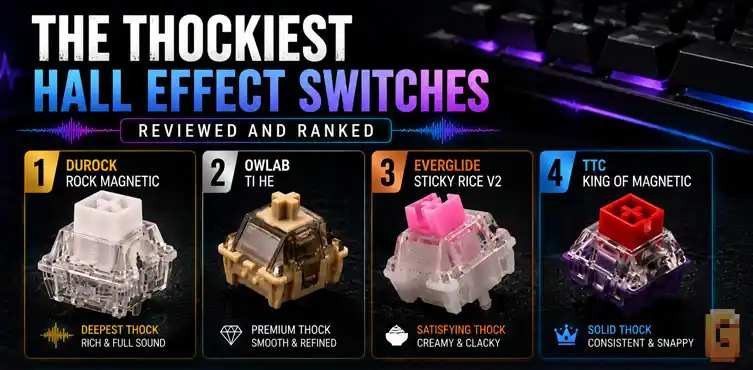

If you’re searching for the thockiest hall effect switches, don’t assume the most popular switch is automatically the deepest sounding. Housing design, materials, stem construction, and spring characteristics matter far more than brand recognition. Today, the strongest evidence points toward the Durock Rock Magnetic, Owlab Ti HE, and Everglide Sticky Rice V2 as the closest Hall Effect switches get to traditional mechanical thock.
Hall Effect keyboards have completely changed the gaming keyboard market. Rapid Trigger, adjustable actuation, contactless operation, and incredible durability have made magnetic switches the default choice for competitive players. If your priority is speed, they’re hard to beat.
Sound, however, is another story.
For years, Hall Effect switches developed a reputation for feeling smooth but sounding hollow. They often lacked the satisfying low-frequency “thock” that mechanical keyboard enthusiasts spend hundreds of dollars chasing through switch choices, plate materials, foam mods, and lubrication. That’s started to change.
Manufacturers are beginning to realize that gamers also care about acoustics. New Hall Effect switches aren’t just becoming smoother—they’re becoming better sounding.
The interesting part is that very few articles explain why. Most buying guides simply rank switches from best to worst. They’ll tell you which switch sounds deeper or which one feels smoother, but they rarely explain the physics behind those differences. Understanding that mechanism makes choosing a switch much easier.
Instead of buying whichever model happens to be popular this month, you can recognize the design choices that consistently produce a deeper sound. That’s exactly what this guide focuses on.
Rather than treating every Hall Effect switch as acoustically identical, we’ll break down why some models produce a fuller bottom-out, why others sound brighter or clackier, and why one of the most popular Hall Effect switches—the Gateron Magnetic Jade—is often misunderstood when people describe it as “thocky.”
If you’re building a gaming keyboard with translucent switches, RGB lighting, and a satisfying sound profile, this guide is designed to answer the questions that most rankings leave unexplained.
Why Most Hall Effect Switch Rankings Miss the Point
Most people searching for the best sounding Hall Effect switch run into the same three issues.
- Every list recommends a different “best” switch
One article ranks the Gateron Magnetic Jade first. Another prefers Everglide Sticky Rice V2. Someone on Reddit insists TTC King of Magnetic is unmatched.
Without understanding why each switch sounds different, these rankings quickly become confusing. This guide focuses on the engineering behind the sound so you can understand the recommendations instead of simply following them.
- Popular doesn’t always mean thocky
One of the biggest misconceptions is that the most popular Hall Effect switch must also be the deepest sounding.
That isn’t necessarily true. Some switches excel because they’re exceptionally smooth. Others are optimized for Rapid Trigger performance. Others simply offer excellent value.
A switch can be outstanding overall while still producing a brighter, creamier sound than buyers expecting true thock. We’ll separate overall quality from acoustic performance throughout this guide.
- Nobody explains why some Hall Effect switches sound better
This is arguably the biggest gap in current buying guides. You’ll often read descriptions like:
- “Deep.”
- “Creamy.”
- “Marbly.”
- “Clacky.”
- “Poppy.”
But those descriptions rarely explain what inside the switch creates those sounds.
Understanding the relationship between housing design, trapped air, materials, stem mass, and spring characteristics makes it much easier to predict how a switch will sound—even before hearing a sound test.
Why Hall Effect Switches Aren’t Naturally Thocky
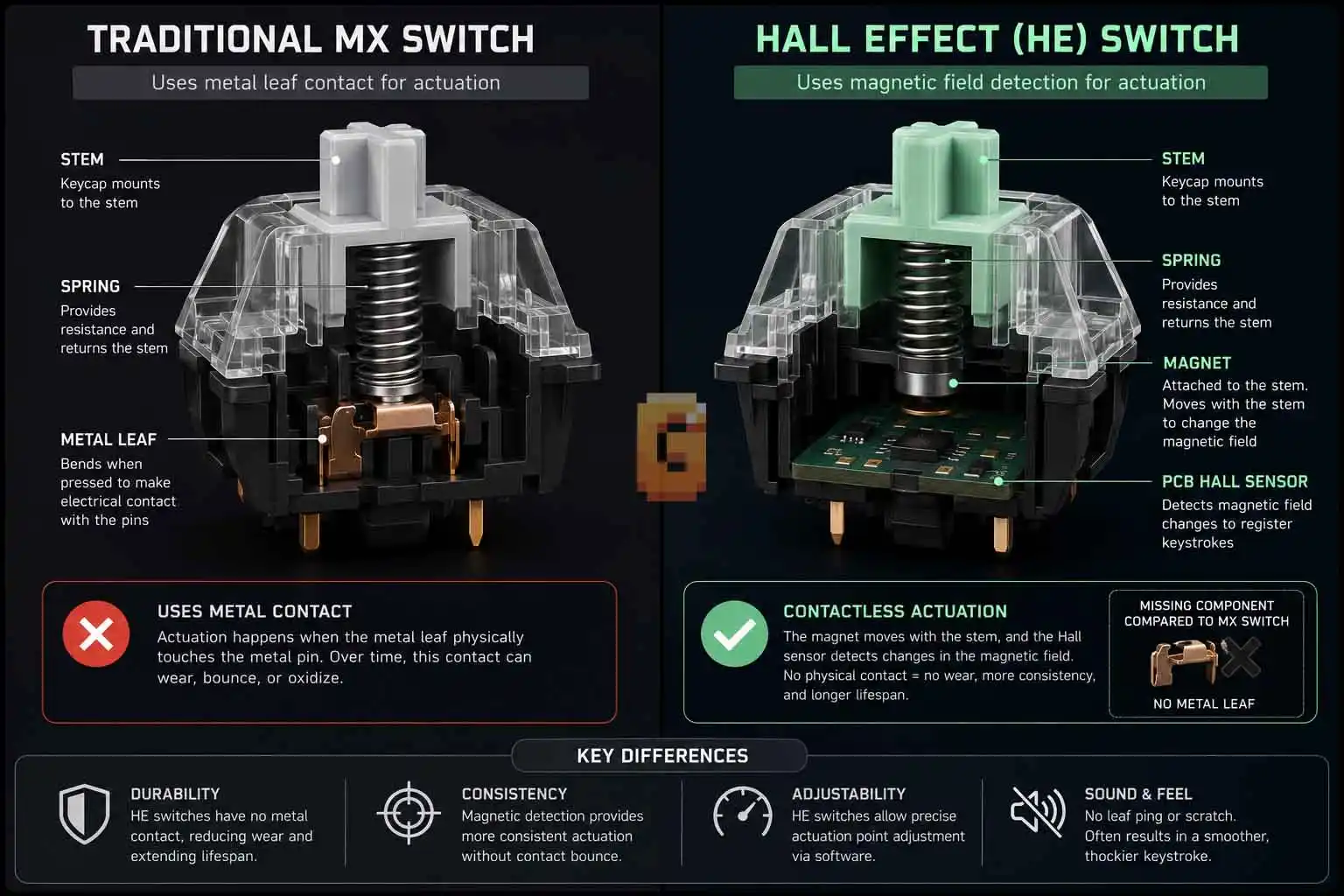
Hall Effect switches are designed primarily for gaming performance, not acoustic performance. Their contactless magnetic operation removes several sources of mechanical noise found in traditional switches, but it also changes how the switch sounds when it bottoms out. That doesn’t mean Hall Effect switches can’t sound good. It simply means they start from a different design philosophy.
Traditional MX switches generate sound from multiple interacting parts.
- The stem strikes the housing.
- The spring compresses and rebounds.
- The metal leaf contributes subtle vibrations.
Every component adds its own character.
Hall Effect switches remove one of those components entirely. Instead of metal contacts completing an electrical circuit, they use magnets and sensors to detect key movement. The result is an incredibly smooth keypress with virtually no debounce delay.
For competitive gaming, that’s fantastic. For acoustics, things become more complicated.
Without the metal leaf, Hall Effect switches naturally produce a cleaner and often quieter sound signature. That smoothness is one reason so many gamers immediately notice how refined Hall Effect keyboards feel. Unfortunately, smooth doesn’t automatically mean deep.
Most early Hall Effect switches also prioritized sensor placement over acoustic tuning. Many adopted relatively open housing designs that simplified manufacturing and magnetic sensing. Those open housings introduced another acoustic problem.
When a switch bottoms out, air inside the housing rapidly compresses. If that air escapes immediately through an open structure, much of the energy disappears. Instead of producing a satisfying low-frequency impact, the switch generates a lighter, sharper sound.
That’s one reason many early Hall Effect keyboards developed a reputation for sounding hollow or clacky compared to enthusiast mechanical keyboards. Modern designs have begun addressing this weakness.
Some manufacturers now use more enclosed housings, improved stem stabilization, and tighter tolerances specifically to improve bottom-out acoustics. Those changes don’t completely erase the acoustic differences between Hall Effect and traditional switches. But they narrow the gap considerably.
Hall Effect switches are not naturally thocky because they prioritize magnetic sensing, smooth operation, and gaming performance over acoustic tuning. Most designs reduce mechanical resonance and allow more air to escape during bottom-out, producing a cleaner but often less bass-heavy sound.
What Actually Makes an HE Switch Thock?
The biggest misconception surrounding Hall Effect switches is that sound comes from lubrication alone.
Lubing certainly helps.
- It reduces scratchiness.
- It minimizes spring noise.
- It smooths out unwanted high-frequency sounds.
But lubrication cannot fundamentally change the acoustic architecture of a switch. If a switch is designed to sound bright, lubrication won’t magically transform it into a deep thock machine.
The biggest differences come from the physical construction of the switch itself.
Housing Design Is the Biggest Factor
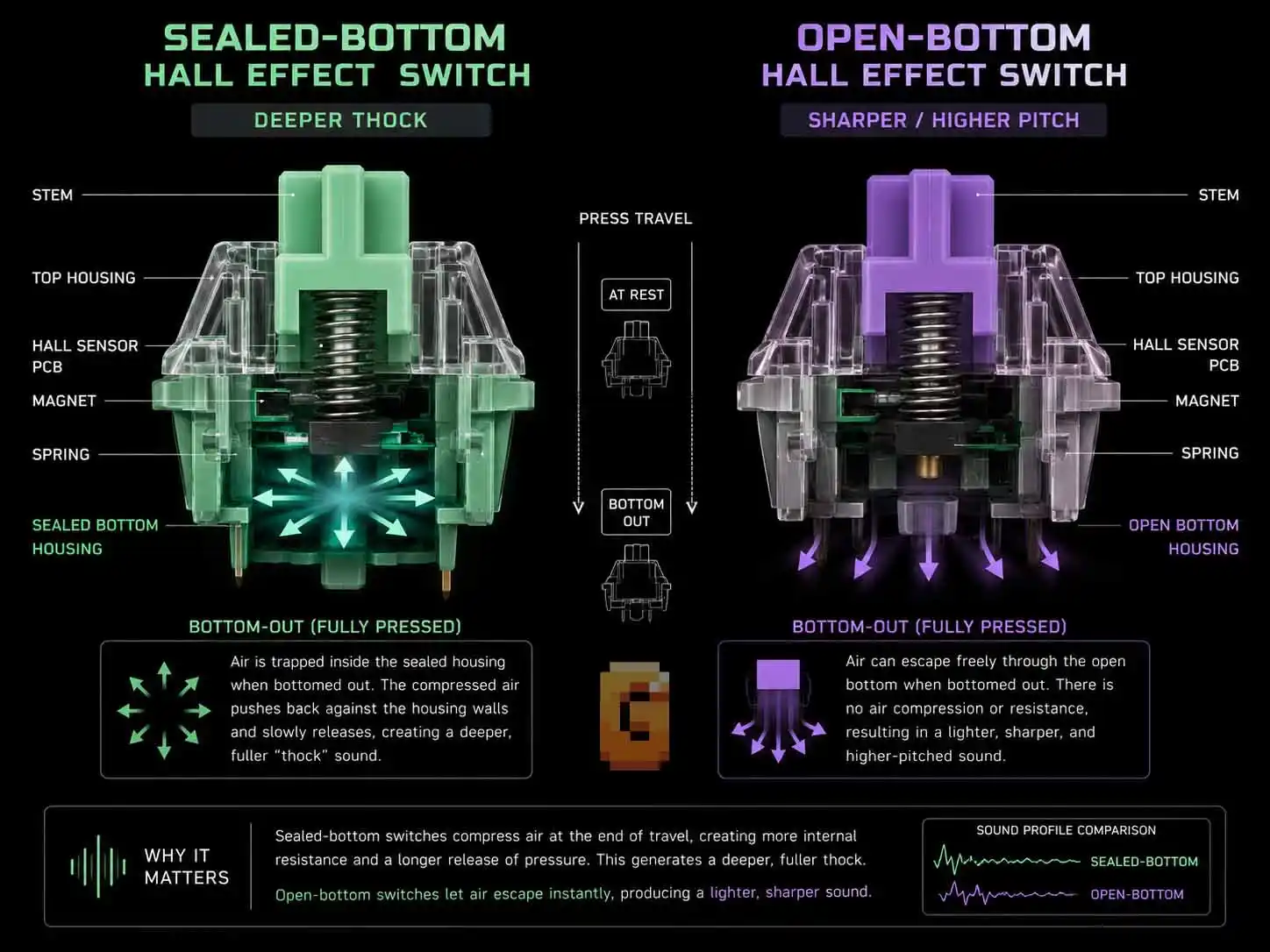
Housing design influences the sound more than almost anything else. This is also the area where Hall Effect switches differ most from traditional mechanical switches.
From an acoustic engineering perspective, one plausible explanation for why more enclosed Hall Effect switches often sound deeper is the way air behaves during bottom-out.
As the stem reaches the bottom of its travel, a more enclosed housing leaves less opportunity for air to escape immediately. The trapped air briefly compresses before venting, which can slightly change how impact energy is transmitted through the switch.
That combination of air compression, housing resonance, and material properties may contribute to the fuller, lower-frequency bottom-out that enthusiasts often describe as “thock.”
By comparison, more open housing designs allow air to escape more freely during bottom-out. From an acoustic standpoint, this generally reduces the air-cushioning effect described above and tends to produce a lighter, brighter impact. Housing material, stem geometry, and mounting style still influence the final sound, so this should be viewed as one contributing factor rather than the only explanation. Instead of hearing a rounded “thock,” you hear more of a crisp “clack.”
This difference is one of the key reasons two otherwise similar Hall Effect switches can produce noticeably different sound signatures, although stem design, housing materials, springs, and keyboard construction all contribute as well. It’s also one of the least discussed aspects of Hall Effect switch design despite having one of the biggest acoustic impacts.
Housing Materials Shape Resonance
Materials matter almost as much as housing geometry. Different plastics resonate differently.
A polycarbonate (PC) housing reflects sound differently than nylon. Likewise, combining a PC top with a nylon bottom produces a different acoustic signature than using the same material throughout the housing. The interaction between those materials affects pitch, resonance, and perceived fullness.
Two switches with identical springs can therefore sound surprisingly different simply because the housing materials absorb and reflect impact energy differently. This is one reason enthusiasts often describe certain switches as sounding “full” while others feel “dry” or “thin.”
Stem Design Changes the Bottom-Out
The stem doesn’t just determine smoothness. It also contributes directly to sound. A heavier stem carries more momentum into bottom-out. Different stem geometries distribute impact forces differently.
One particularly interesting example is the Durock Rock Magnetic. Unlike most Hall Effect switches, it incorporates a metal insert inside the stem. That additional mass changes the impact characteristics and creates a distinctive acoustic signature that reviewers consistently describe as unique within the Hall Effect category.
It’s a reminder that even relatively small engineering decisions can produce audible differences.
Springs Affect More Than Key Weight
Most people think springs only determine how heavy a switch feels. They influence much more than that.
Spring characteristics affect rebound speed, return acoustics, and overall typing rhythm. Some Hall Effect switches are noted for using unusually long springs compared to most competitors. Rather than changing bottom-out directly, these springs alter how the switch returns after release.
The result can subtly shift the overall sound profile, giving the keyboard a slightly deeper and more substantial acoustic character during rapid typing.
Spring tuning alone won’t create thock. Combined with the right housing and stem, however, it becomes another important piece of the puzzle.
Tight Manufacturing Reduces Unwanted Noise
Acoustic quality isn’t only about adding bass. It’s also about removing distractions.
- Stem wobble.
- Housing movement.
- Spring ping.
- Plastic rattle.
All of these unwanted sounds compete with the bottom-out.
Modern premium Hall Effect switches often feature tighter manufacturing tolerances, improved factory lubrication, and better stem stabilization. Removing those unwanted noises allows the intended bottom-out sound to become much more noticeable. Ironically, making a switch sound deeper often begins by making everything else quieter.
The deepest Hall Effect switches combine a more enclosed housing, carefully chosen housing materials, stable stem construction, and well-tuned springs. Those design choices shape the bottom-out far more than lubrication alone.
How We Ranked These Switches
This article isn’t ranking the best Hall Effect switches overall. It’s ranking the thockiest Hall Effect switches specifically for people chasing a deeper acoustic profile.
That distinction matters. Some excellent gaming switches rank lower here simply because they prioritize speed and smoothness over sound.
Our rankings are based on four consistent factors:
- Bottom-out depth and overall pitch.
- Housing design and acoustic engineering.
- Physical switch construction, including stem and spring design.
- Consensus across multiple independent reviews from LumeKeebs, Milktooth, and Toronto KeyboardMan.
Gaming performance, Rapid Trigger compatibility, RGB friendliness, and overall smoothness are still considered. However, they act as tie-breakers rather than primary ranking criteria.
If two switches perform similarly acoustically, the better gaming switch earns the higher position. If one switch sounds significantly deeper than another, acoustic performance takes priority because that’s the central question this article is answering.
The Thockiest Hall Effect Switches, Ranked
| Switch | Housing Design | Housing Material | Stem Feature | Sound Character |
|---|---|---|---|---|
| Durock Rock Magnetic | Enclosed | Full polycarbonate (top + bottom) | Metal insert — adds mass | Deep, low-pitched, solid |
| Owlab Ti HE | Standard | PC + titanium elements | Tight tolerances, minimal wobble | Crisp, full, authoritative |
| Everglide Sticky Rice V2 | Sealed bottom | PC/nylon | Dust-sealed stem | Warm, rounded, neutral |
| TTC King of Magnetic | Standard | Standard plastic | Factory lubed | Fuller than average, satisfying |
| TTC Magneto | Standard | Standard | Unusually long springs | Lively rebound, bassy return |
| Gateron Magnetic Jade | Closed (not sealed) | PC top + nylon bottom | POM stem, low wobble | Creamy, mid-range, poppy |
Now that we’ve covered the physics behind switch acoustics, it’s time to answer the question;
Which Hall Effect switches actually sound the thockiest?
This ranking focuses on acoustic performance first, with gaming performance, smoothness, and RGB compatibility acting as secondary factors. A switch isn’t ranked higher simply because it’s more popular. Instead, it earns its place based on how convincingly it delivers a satisfying, low-frequency bottom-out while still offering the responsiveness expected from a modern Hall Effect keyboard.
The Hall Effect category still doesn’t produce the same variety of sound signatures as traditional MX switches. Even so, a handful of designs stand out by combining smart engineering with excellent gaming performance.
1. Durock Rock Magnetic — The Current Thock Benchmark
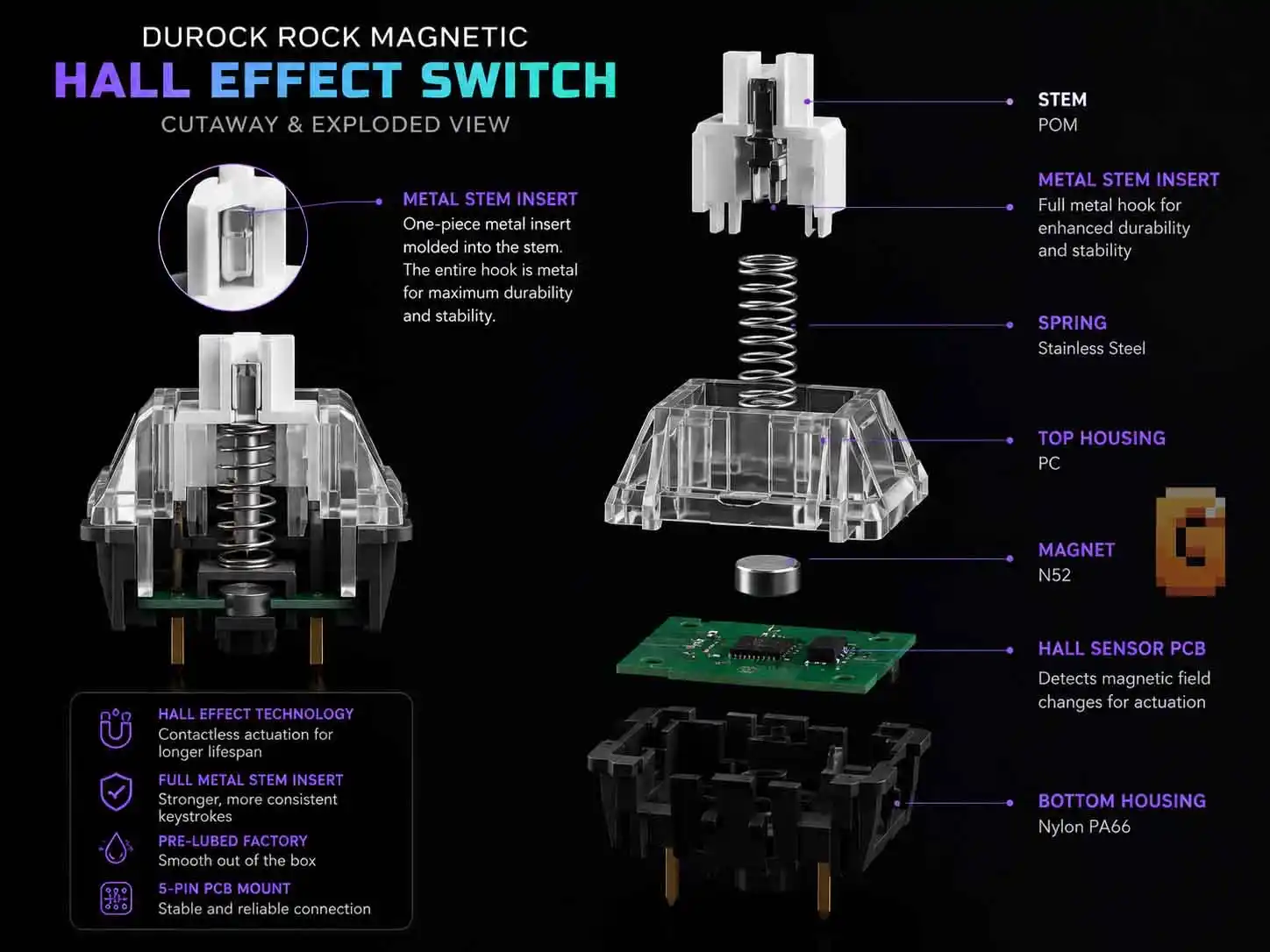
If your goal is pure acoustic satisfaction, the Durock Rock Magnetic currently sets the benchmark among Hall Effect switches.
Unlike many competitors that focus almost exclusively on smoothness, Durock appears to have paid close attention to the entire bottom-out experience.
One of its defining characteristics is the metal insert integrated into the stem. That additional mass changes the way the switch impacts the housing during bottom-out, creating a noticeably fuller sound than most magnetic switches.
Housing design also plays a major role. Compared with more open Hall Effect housings, the Rock Magnetic uses a more enclosed structure that better contains air during bottom-out. As explained earlier, trapped air briefly compresses before escaping, contributing to a lower-pitched and more substantial impact. The result is a sound profile that reviewers consistently describe as one of the deepest available in the Hall Effect category.
It still doesn’t perfectly replicate the heavy “thock” of enthusiast MX switches built around long-pole stems, gasket mounts, and carefully tuned foam stacks. But within the magnetic switch market, it comes remarkably close.
For gamers, the good news is that pursuing better acoustics doesn’t require sacrificing Hall Effect advantages. You still retain the adjustable actuation, Rapid Trigger support, and smooth contactless operation that make magnetic keyboards so appealing in the first place.
If your keyboard’s primary purpose is gaming but you refuse to settle for a thin or hollow sound, the Durock Rock Magnetic is currently the strongest candidate.
2. Owlab Ti HE — Premium Thock with Titanium Construction
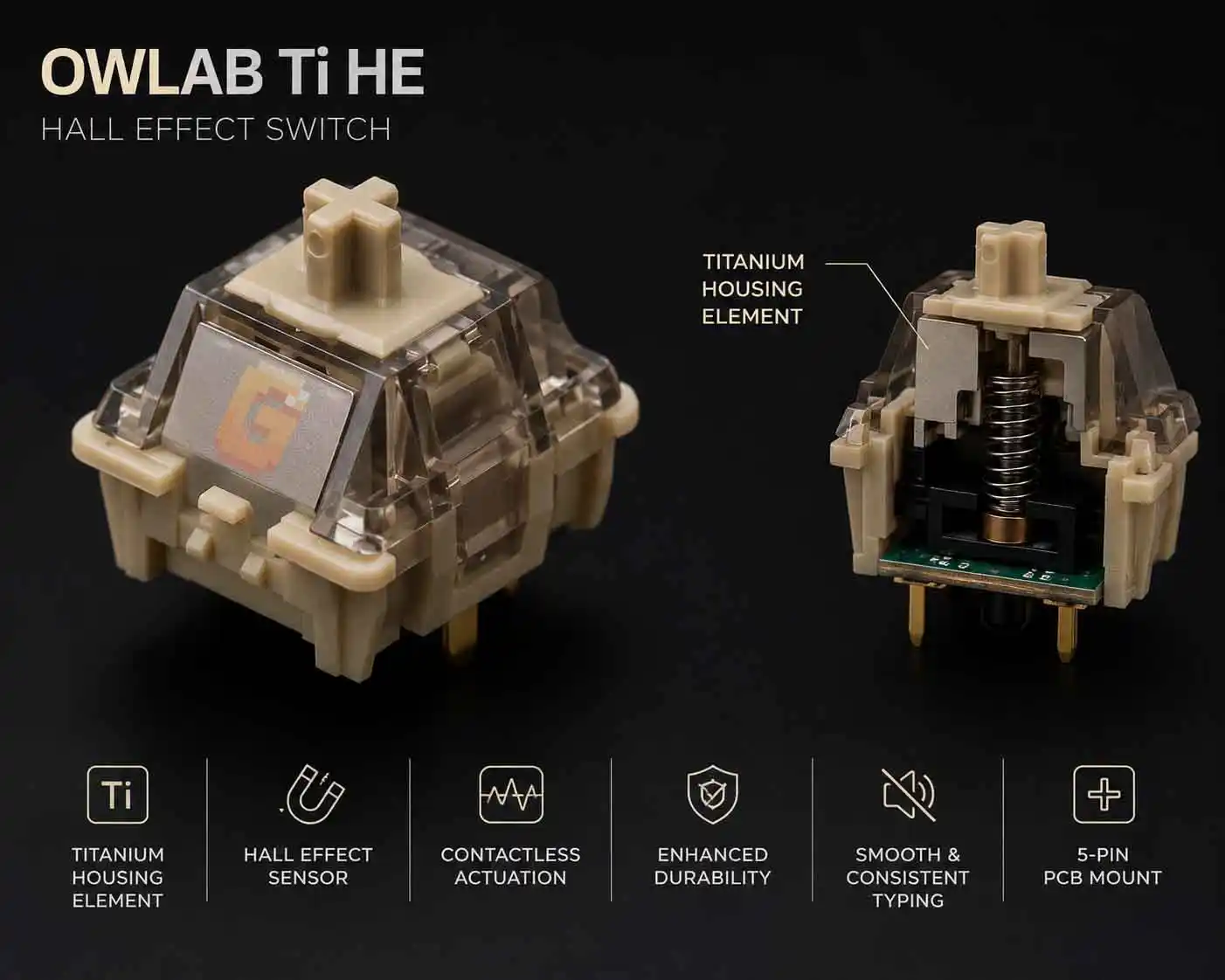
The Owlab Ti HE occupies an interesting position in the Hall Effect market.
Rather than chasing an extremely soft or muted sound, it produces a bottom-out that feels crisp while maintaining impressive fullness. Multiple reviewers describe its sound as closer to a traditional enthusiast mechanical switch than many competing Hall Effect designs.
The switch’s titanium construction—reflected in its name—helps produce a crisper, fuller bottom-out than many switches built entirely around standard plastic housings. Instead of sounding overly bright, the impact carries more authority than many gamers expect from a Hall Effect switch.
That balance makes it particularly attractive for users who want a premium sound without moving completely away from the clean, precise character magnetic switches are known for.
The Owlab Ti HE doesn’t necessarily replace the Durock Rock Magnetic as the deepest option available. Instead, it offers a different interpretation of premium acoustics. Where the Durock emphasizes low-frequency impact, the Owlab leans toward a cleaner, fuller presentation with excellent definition. Some listeners may actually prefer that balance.
If your keyboard doubles as both a competitive gaming tool and a daily typing board, the Owlab Ti HE deserves serious consideration.
3. Everglide Sticky Rice V2 — The Best Traditional Thock Character
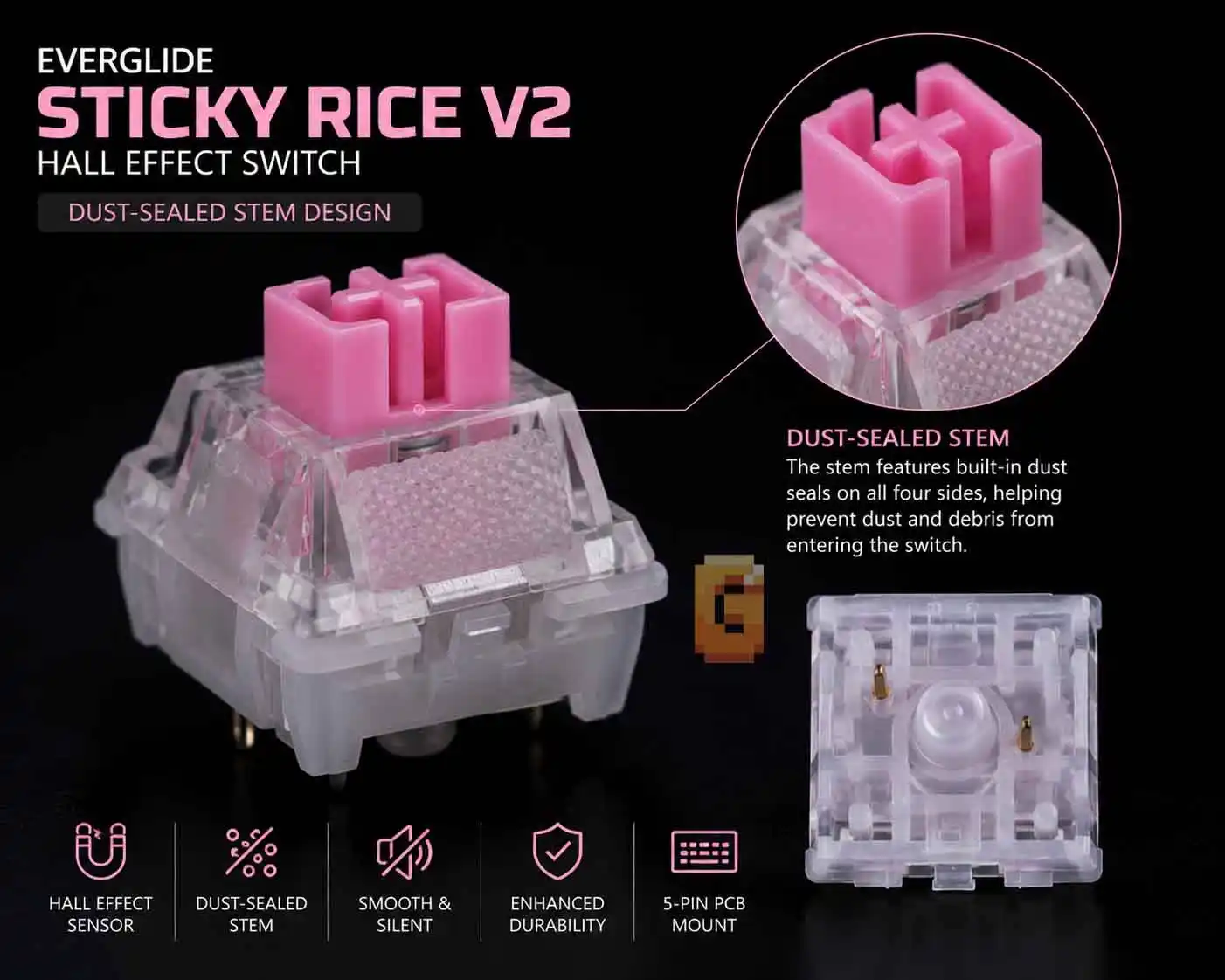
If you’ve spent time in the custom keyboard community, you’ve probably heard the Sticky Rice name before. The Hall Effect version continues that reputation surprisingly well.
Among currently available magnetic switches, the Sticky Rice V2 is frequently recommended by enthusiasts looking for a deeper, more traditional mechanical keyboard sound.
Instead of emphasizing a bright pop or a sharp clack, it leans toward a lower-pitched, more rounded bottom-out. That distinction may seem subtle on paper. In practice, it’s one of the reasons this switch repeatedly appears near the top of discussions about the best sounding Hall Effect switches.
Its factory lubrication and stable construction also help reduce unwanted mechanical noise.
Less stem wobble and less spring noise allow the switch’s intended sound signature to come through more clearly. The result isn’t just a quieter switch. It’s a cleaner one.
For buyers who want a Hall Effect keyboard that still reminds them of a well-tuned custom mechanical build, Sticky Rice V2 represents one of the strongest compromises currently available.
4. TTC King of Magnetic — Surprisingly Deep for Competitive Gaming
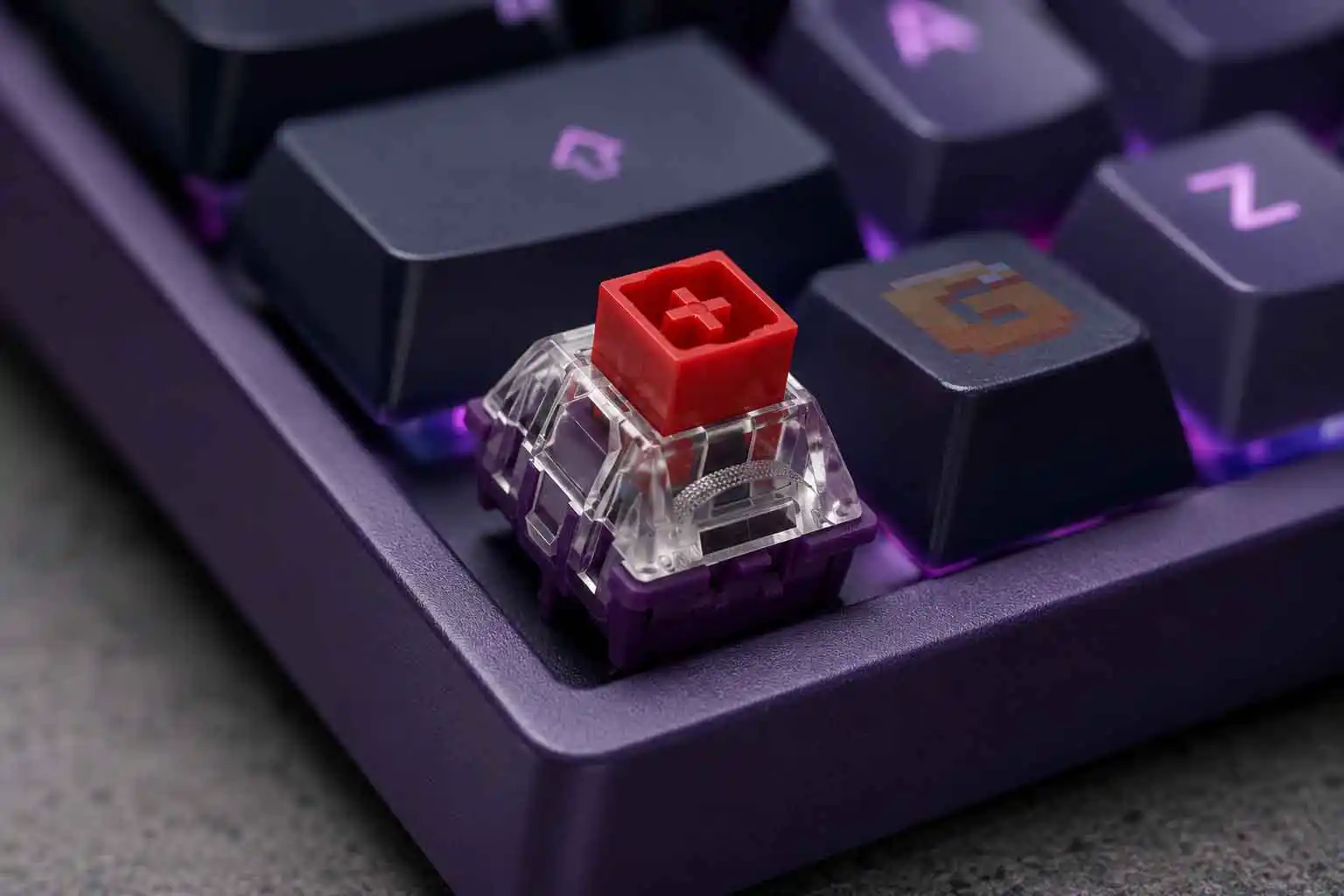
The TTC King of Magnetic occupies an interesting middle ground.
It remains first and foremost a high-performance gaming switch. At the same time, several reviewers have highlighted its unusually satisfying sound compared with many competing Hall Effect designs.
Rather than sounding hollow, it produces a fuller and more substantial bottom-out than many gaming-focused switches. That doesn’t necessarily make it deeper than the top three in this ranking. However, it demonstrates that gaming-oriented switches don’t always have to sacrifice acoustic quality.
For competitive players who value Rapid Trigger performance but still want a keyboard that sounds refined, the TTC King of Magnetic deserves consideration.
TTC’s Tai’e Sword is a related but distinct switch from the same manufacturer — worth considering alongside the KOM if your board supports TTC’s magnetic lineup.
Honorable Mentions
Not every excellent Hall Effect switch lands near the very top of a thock-focused ranking. Some prioritize smoothness. Others emphasize a brighter, more energetic sound signature. They’re still excellent products—they simply pursue different acoustic goals.
- TTC Magneto
TTC’s Magneto is widely recognized for using some of the longest springs available in any Hall Effect switch.
Rather than dramatically changing the bottom-out itself, those longer springs influence the return stroke, contributing to a deeper, bassier rebound than many competing HE switches.
If you enjoy a keyboard that feels lively while still offering more low-frequency feedback than average, the Magneto is well worth considering. Its strength isn’t maximum thock. It’s the balance between gaming responsiveness and a richer overall sound profile.
- Wuque WS Dash HE
The Wuque WS Dash HE takes a different approach. Instead of chasing maximum depth, it delivers an exceptionally clean and crisp acoustic presentation.
Its stable construction and tight manufacturing tolerances minimize unwanted noise, allowing each keypress to sound consistent across the board. Many users appreciate that precision.
If your preference leans toward a brighter and more defined keyboard rather than the deepest possible bottom-out, the WS Dash HE remains one of the strongest Hall Effect options available.
Is the Gateron Magnetic Jade Thocky?
Short answer: No—not if your definition of “thocky” is a deep, bass-heavy bottom-out.
This is probably the biggest misconception surrounding Hall Effect switches today. The Gateron Magnetic Jade is one of the most recommended magnetic switches on the market.
- It’s exceptionally smooth.
- It’s highly consistent.
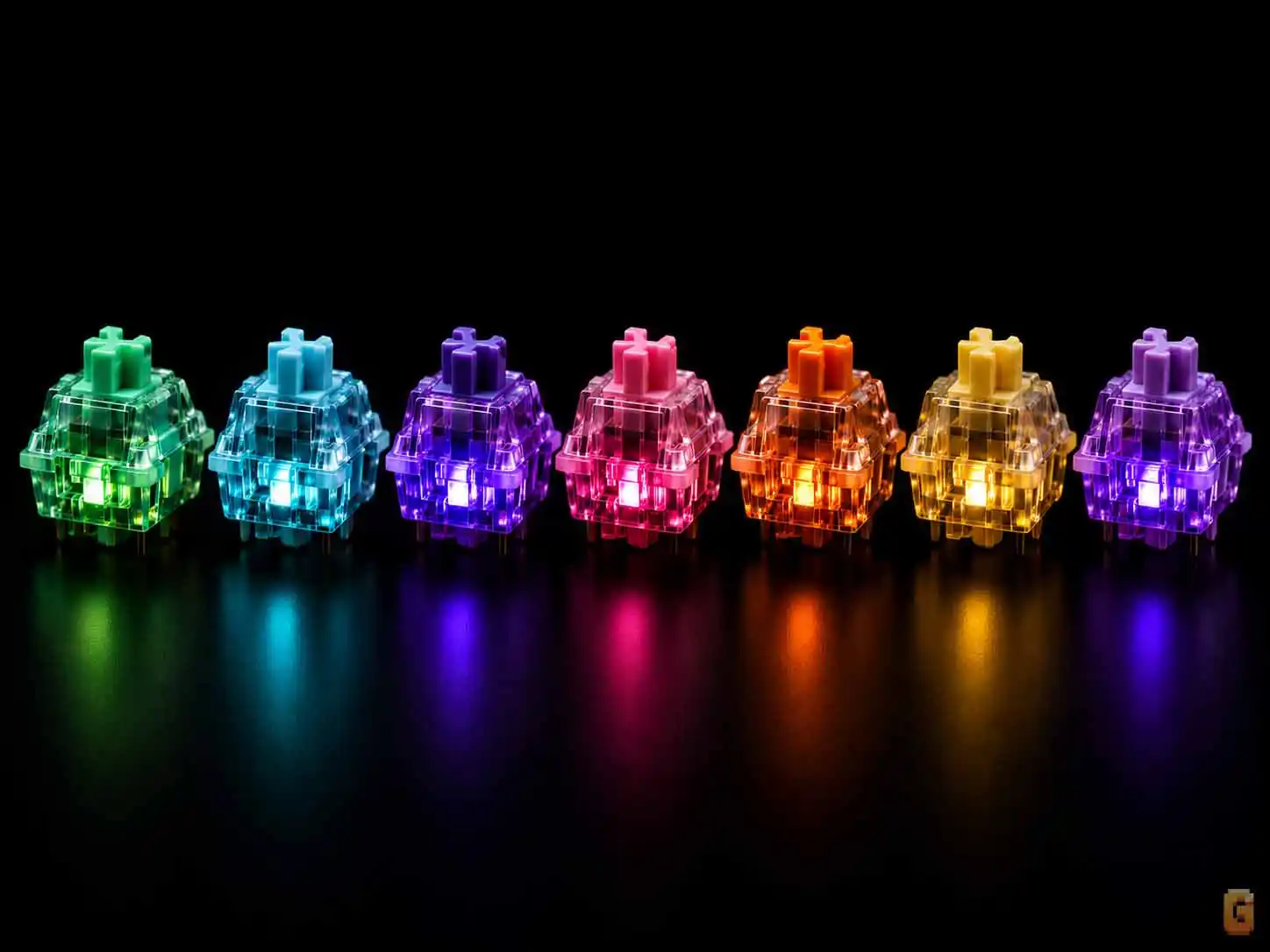
- Its transparent housing makes it an excellent choice for RGB-heavy keyboards.
- Its gaming performance is outstanding.
Those strengths have helped it become one of the default recommendations for Hall Effect enthusiasts.
Unfortunately, popularity has created an assumption that it must also be the deepest sounding switch available. That’s where expectations often become disconnected from reality.
Most reviewers describe the Magnetic Jade using words like creamy, clean, full, or poppy. Those aren’t the same thing as thocky.
A creamy switch typically emphasizes a smooth, rounded sound with noticeable mid-frequency presence. A truly thocky switch shifts more energy toward the lower frequencies, producing a heavier and more substantial bottom-out.
The Jade certainly sounds better than many early Hall Effect switches. Compared with older magnetic designs, it’s noticeably more refined. However, refinement shouldn’t be confused with depth. If your goal is maximizing acoustic bass, several switches outperform it.
That doesn’t make the Jade a poor purchase. Far from it.
For many gamers, it remains one of the best all-around Hall Effect switches available because it combines excellent smoothness, reliable Rapid Trigger performance, and outstanding RGB compatibility. It simply occupies a different place on the acoustic spectrum.
Think of it this way:
If you’re shopping for the best overall Hall Effect switch, the Magnetic Jade absolutely belongs in the conversation.
If you’re shopping specifically for the thockiest Hall Effect switch, it’s no longer the obvious answer.
That’s an important distinction, and one that’s often lost when articles rank switches based solely on overall quality.
The Gateron Magnetic Jade is best described as creamy and full rather than truly thocky. It’s one of the best all-around Hall Effect switches for gaming, but buyers chasing the deepest bottom-out should look toward options like the Durock Rock Magnetic, Owlab Ti HE, or Everglide Sticky Rice V2 instead.
If you’re weighing the standard Jade against its Pro variant specifically, our Wooting Lekker V2 vs Gateron Magnetic Jade Pro comparison covers how the Jade Pro’s lighter spring stacks up against a completely different Hall Effect approach.
Choosing the Right Switch for Your Priorities
By now, one thing should be clear;
There isn’t a single “best” Hall Effect switch for everyone. The right choice depends on what you’re trying to optimize.
If sound is your highest priority, the Durock Rock Magnetic currently stands at the top thanks to its distinctive stem design and acoustic engineering.
If you want a premium blend of performance and refined acoustics, the Owlab Ti HE offers one of the most convincing enthusiast-style sound signatures in the category.
If you’re looking for a deeper, more traditional mechanical keyboard character without giving up Hall Effect technology, the Everglide Sticky Rice V2 remains one of the safest recommendations.
Meanwhile, if gaming performance, RGB brightness, and buttery smooth travel matter more than absolute acoustic depth, the Gateron Magnetic Jade continues to be one of the strongest all-around choices despite not being the thockiest option. New exclusive switches keep entering the market too — our review of the ATK VELOTA FUZZY 60 V2 covers how its proprietary Silver Regent King switches and 5-layer damping system approach the same acoustic goals from a factory-tuned angle.
That distinction is exactly why understanding the engineering matters more than memorizing rankings. Once you know why switches sound different, choosing the right one becomes much easier rather than relying solely on someone else’s top-ten list.
Once you’ve picked a switch, you’ll want a hot-swappable board to drop it into — our WLMOUSE Ying75 HE review covers one of the more popular Hall Effect options currently available.
Frequently Asked Questions
Are Hall Effect switches naturally thocky?
No. Hall Effect switches are generally designed around gaming performance rather than acoustics. Their magnetic sensing mechanism and common housing designs often produce a cleaner, brighter sound than traditional mechanical switches, although newer premium designs have significantly narrowed the gap.
Which Hall Effect switch is the thockiest?
Based on current reviewer consensus, the Durock Rock Magnetic is the strongest candidate. Its combination of a more enclosed housing and a metal stem insert consistently produces one of the deepest bottom-out sounds in the Hall Effect category.
Is the Gateron Magnetic Jade thocky?
Not in the traditional sense. The Gateron Magnetic Jade is better described as creamy, smooth, and full. It’s an excellent all-around Hall Effect switch, but buyers specifically chasing a deep, bass-heavy bottom-out may prefer other options.
Do translucent switch housings reduce thock?
Not necessarily. A transparent or translucent housing doesn’t automatically make a switch sound brighter. Housing geometry, material combinations, stem design, and overall construction have a much larger impact on acoustics than transparency alone.
Does lubrication make a Hall Effect switch thockier?
Only to a limited extent. Lubrication reduces scratchiness, spring noise, and unwanted high-frequency sounds. It can make a switch sound cleaner, but it cannot fundamentally change the acoustic character created by the housing, stem, and spring design.
Are Hall Effect switches better for gaming than traditional mechanical switches?
For many competitive players, yes. Features such as adjustable actuation and Rapid Trigger give Hall Effect switches advantages in fast-paced games. Whether those advantages outweigh the broader switch selection and acoustic potential of traditional mechanical switches depends on your priorities.
Recommended for Different Buyers
| Switch | Thock Level | Sound Profile | Best For | Skip If |
|---|---|---|---|---|
| Durock Rock Magnetic | ★★★★★ | Deep, low-pitched | Maximum thock is the priority | Budget is the constraint |
| Owlab Ti HE | ★★★★ | Crisp and full | Premium acoustics + gaming precision | You want pure bass over definition |
| Everglide Sticky Rice V2 | ★★★★ | Warm and rounded | Traditional mech feel in an HE switch | You prefer a brighter sound |
| TTC King of Magnetic | ★★★ | Deeper than average | Competitive gaming with decent thock | Thock is your only goal |
| TTC Magneto | ★★★ | Bassy rebound | Lively typing feel with low-end feedback | You bottom out hard every keystroke |
| Gateron Magnetic Jade | ★★ | Creamy, mid-range | All-around gaming and RGB builds | Thock is what you came for |
If you’re still undecided, here’s a simple way to narrow your options.
Buy the Durock Rock Magnetic if…
- Sound quality is your highest priority.
- You want the deepest bottom-out currently available in a Hall Effect switch.
- You’re willing to pay more for premium acoustics.
Buy the Owlab Ti HE if…
- You want a premium enthusiast-style sound.
- You like a fuller, crisper bottom-out rather than an extremely muted one.
- You want excellent gaming performance alongside refined acoustics.
Buy the Everglide Sticky Rice V2 if…
- You enjoy the sound of traditional mechanical keyboards.
- You want a lower-pitched Hall Effect switch without sacrificing smoothness.
- You prefer a balanced compromise between gaming and typing.
Buy the Gateron Magnetic Jade if…
- Gaming performance is your first priority.
- RGB brightness matters.
- You want one of the smoothest Hall Effect switches available.
- You’re happy with a creamy sound instead of maximum thock.
Key Takeaways
If you only remember a few things from this guide, make them these:
- Hall Effect switches are not naturally thocky because they’re primarily engineered for magnetic sensing and gaming performance rather than acoustics.
- Housing design is widely regarded as one of the biggest influences on bottom-out sound, particularly when considered alongside housing materials, stem construction, and spring characteristics.
- Material choice also matters. Different housing materials resonate differently, changing both pitch and perceived fullness.
- Stem construction influences impact characteristics. Additional stem mass can noticeably alter the bottom-out sound.
- Springs contribute more than key weight. Their characteristics also shape rebound feel and the keyboard’s overall acoustic personality.
- Lubrication improves smoothness and reduces unwanted noise, but it cannot fundamentally transform a bright switch into a truly thocky one.
- The Gateron Magnetic Jade is one of the best overall Hall Effect switches, but its sound is better described as creamy than deeply thocky.
Final Verdict
Hall Effect keyboards have matured rapidly over the past few years. Early magnetic switches often forced buyers to choose between exceptional gaming performance and satisfying acoustics. That trade-off is becoming smaller with every new generation.
Manufacturers are beginning to pay far more attention to housing design, stem engineering, material selection, and overall acoustic tuning than they did in the first wave of Hall Effect products. As a result, today’s premium magnetic switches sound dramatically better than many gamers expect.
The biggest lesson, however, is that “best” depends on what you’re actually looking for. If you’re chasing the deepest possible bottom-out, popularity alone isn’t a reliable guide.
Understanding the engineering behind switch acoustics makes it much easier to separate genuinely thocky designs from switches that are simply smooth or well marketed.
Right now, the available evidence consistently points toward the Durock Rock Magnetic as the benchmark for maximum thock, with the Owlab Ti HE and Everglide Sticky Rice V2 forming an exceptionally strong second tier.
Meanwhile, the Gateron Magnetic Jade remains one of the best overall Hall Effect switches on the market—it simply shouldn’t be mistaken for the deepest sounding option.
The thock ceiling in Hall Effect switches is still lower than in traditional mechanical switches. But if you want Rapid Trigger, adjustable actuation, excellent RGB compatibility, and a keyboard that also delivers satisfying acoustics, the Durock Rock Magnetic, Owlab Ti HE, and Everglide Sticky Rice V2 are about as close as the category currently gets.
If you’re planning a new gaming keyboard build, use this guide as a starting point—not just to compare products, but to understand the engineering that shapes how every keypress sounds. Once you know what creates thock, you’ll be able to evaluate future Hall Effect switches with far more confidence than any simple top-10 list can provide.
References
- LumeKeebs – https://lumekeebs.com/
- Milktooth – https://milktooth.com/
- Toronto KeyboardMan – https://torontokeyboardman.ca/blogs/news/which-magnetic-switch-should-i-pick-ttc-vs-gateron