

Will RTX 6090 Be Better Than 5090? Why Waiting for Feynman May Be Smarter
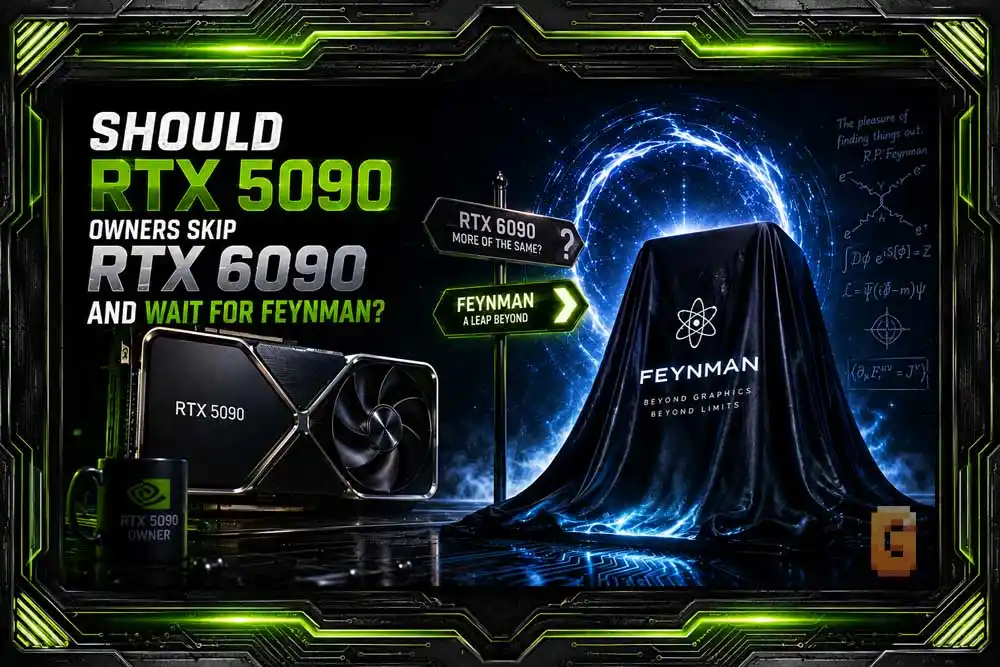

Will RTX 6090 be better than 5090? Almost certainly yes. Based on NVIDIA’s recent flagship scaling trend and current Rubin roadmap signals, a roughly 20–35% gaming performance improvement appears more plausible than a massive 50%+ leap. However, RTX 5090 owners may ultimately find Feynman’s expected platform-level innovations more compelling than Rubin’s likely incremental gains.
Will RTX 6090 Be Better Than 5090? Why Waiting for Feynman May Be the Better Upgrade Strategy
Every modern NVIDIA flagship has outperformed the model that came before it, and there is currently no reason to believe Rubin will break that pattern.
The real question is not whether the RTX 6090 will be faster. The real question is whether it will be enough faster to justify replacing an RTX 5090.
Based on NVIDIA’s publicly discussed roadmap, Rubin appears to be an evolutionary architecture focused on refinement, efficiency, and continued AI acceleration. That “continued AI acceleration” phrase is doing a lot of work, and it’s worth understanding what it means at the hardware level. Modern GPUs increasingly measure AI performance through ultra-low-precision formats like FP4 and INT4 rather than the traditional FP32 numbers gamers are used to comparing. If Rubin pushes further in that direction, RTX 6090’s AI-related specs could look very different from RTX 5090’s — our explainer on FP32, INT32, FP4, and INT4 covers what those numbers actually mean and why they’re becoming as important as traditional gaming benchmarks.
Feynman, by contrast, appears positioned as a broader platform transition involving technologies such as advanced packaging, optical interconnects, and next-generation memory approaches.
For existing RTX 5090 owners, the decision may ultimately be less about 5090 versus 6090 and more about whether Rubin or Feynman represents the next truly meaningful upgrade opportunity.
Performance Expectations: What the Current Signals Suggest
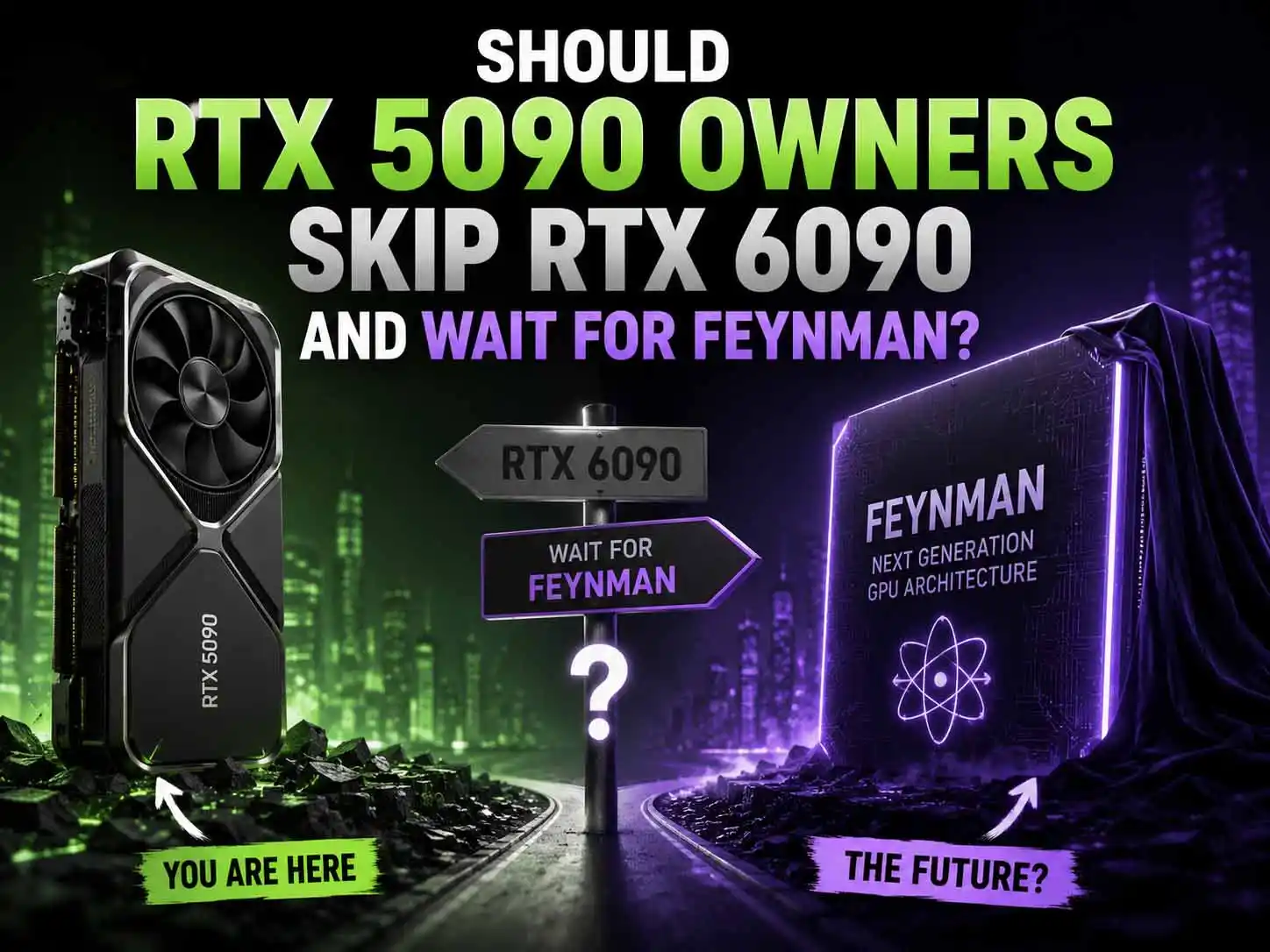
The RTX 6090 is expected to outperform the RTX 5090. The challenge is estimating how much faster it may be.
Because NVIDIA has not released official consumer RTX 6090 specifications, any performance estimate must be treated as analysis rather than fact.
My current projection is a roughly 20–35% gaming performance improvement over RTX 5090. That 20–35% figure is essentially the real-world answer to ‘will RTX 6090 be better than 5090’ — yes, but as a meaningful refinement rather than a generational leap.
It’s worth keeping in mind that this 20–35% projection is about average FPS, not the full smoothness picture. A faster GPU alone won’t necessarily fix stutters if your CPU, RAM, or storage become the new bottleneck — our guide to 1% low and 0.1% low FPS explains why those numbers often matter more than the headline average when you’re deciding whether an upgrade is actually worth it.
How This Estimate Was Reached
The estimate comes from a combination of historical flagship scaling patterns and NVIDIA’s current roadmap direction.
The following table reflects broad market observations rather than official NVIDIA performance claims.
| Upgrade | General Market Perception |
|---|---|
| RTX 3090 → RTX 4090 | Massive leap |
| RTX 4090 → RTX 5090 | Significant but smaller leap |
| RTX 5090 → RTX 6090 (projection) | Moderate improvement likely |
The trend suggests that flagship scaling becomes increasingly difficult as GPUs grow larger, consume more power, and approach practical engineering limits.
The RTX 4090 benefited from a particularly strong architectural jump combined with substantial efficiency improvements. Current roadmap signals do not yet indicate that Rubin represents a larger architectural reset than Blackwell.
Because Rubin currently appears to be an evolutionary generation rather than a revolutionary one, a performance increase broadly comparable to—or slightly smaller than—the previous flagship transition appears more defensible than expectations of a dramatic leap.
That is why I currently view a 20–35% uplift as more plausible than a 50%+ jump.
Why RTX 5090 Owners Face A Different Upgrade Decision
Most future GPU discussions assume the reader needs additional performance immediately.
RTX 5090 owners are in a very different position.
The card already occupies the highest tier of consumer graphics hardware. That changes the upgrade calculation.
The Three Biggest Concerns
The most common concerns among flagship owners are:
- Paying flagship prices for relatively modest gains.
- Upgrading immediately before a major architectural transition.
- Missing out on technologies that could reshape gaming workloads over the next decade.
These concerns help explain why Feynman is generating so much interest despite being further away.
There’s a practical layer to this too. Flagship GPUs like the RTX 5090 already push power delivery and cooling close to their limits, and an evolutionary Rubin generation is unlikely to ease that demand. That concern starts at the PSU level before it even reaches the motherboard. High-wattage flagship builds are exactly the scenario where understanding the difference between single-rail and multi-rail PSU designs stops being an abstract spec-sheet question. Our guide to single rail vs multi rail PSU explained covers what rail configuration means for OCP behavior in practice, why the virtual vs physical distinction is the more important debate, and what ATX 3.1 compliance means for a flagship GPU build.
For anyone asking ‘will RTX 6090 be better than 5090’ enough to justify a fresh build, it’s worth remembering that motherboard VRM cooling becomes more critical as flagship power draw climbs — not just the GPU itself.
Rubin vs Feynman: The Comparison That Actually Matters
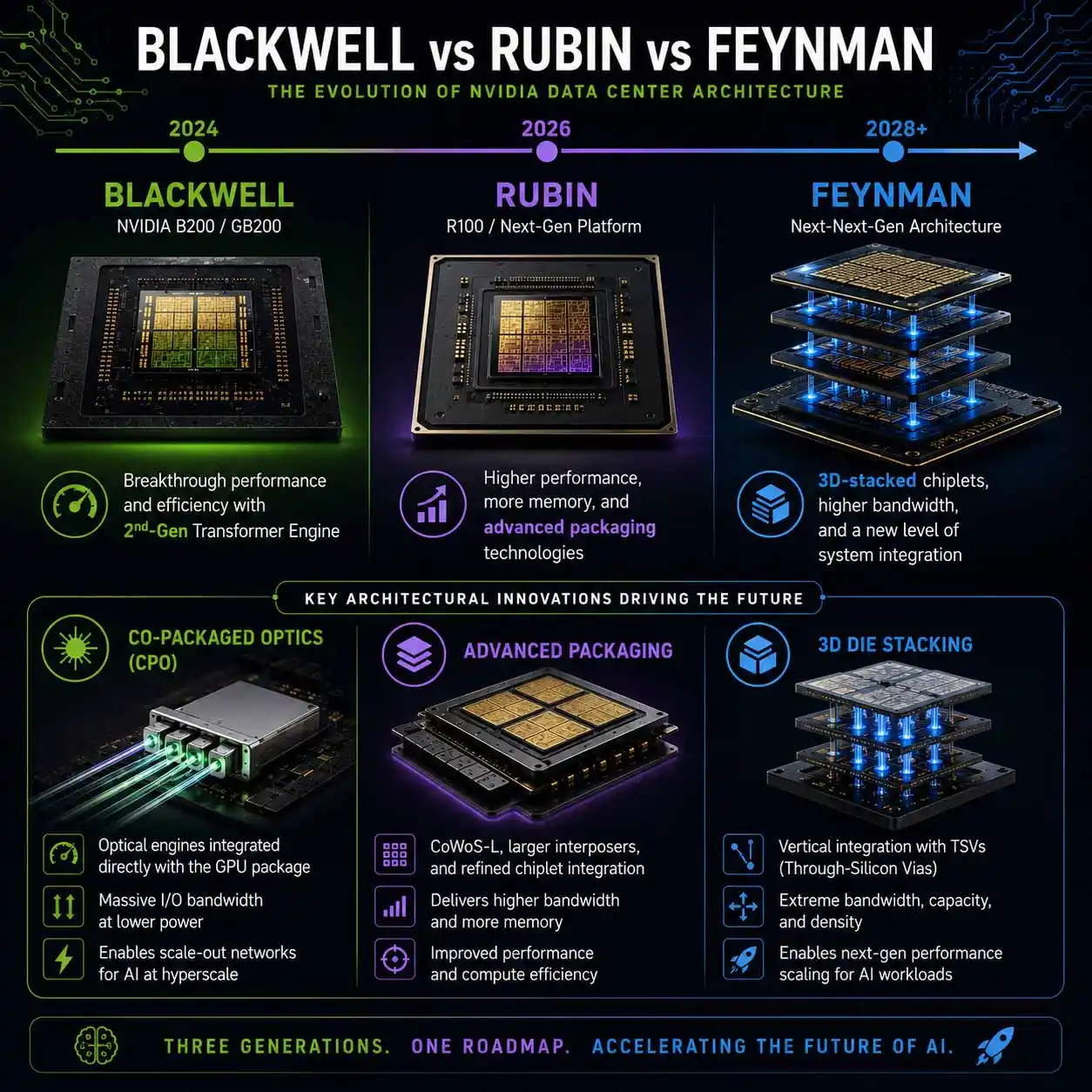
At this stage, will RTX 6090 be better than 5090 is the easy part of the question — the architecture table below is where the real decision lives. For existing RTX 5090 owners, the most important comparison may not be RTX 5090 versus RTX 6090.
It may be RTX 6090 versus Feynman.
Architecture Comparison
| Category | RTX 5090 (Blackwell) | RTX 6090 (Rubin Expected) | Feynman (Expected) |
|---|---|---|---|
| Design Philosophy | Current flagship architecture | Evolutionary refinement | Potential platform transition |
| Primary Goal | Maximum performance | Efficiency and scaling improvements | New scaling technologies |
| Memory Direction | Existing architecture | Further advancement | Custom memory approaches discussed |
| Interconnects | Traditional electrical methods | Traditional electrical methods | Optical interconnect technologies discussed |
| Packaging | Advanced packaging | Improved packaging | 3D stacking and advanced integration |
| Upgrade Impact | Current flagship | Moderate | Potentially transformative |
The key takeaway is simple.
Rubin appears focused on improving the current formula.
Feynman appears focused on changing the formula.
Why Feynman Is Generating So Much Interest
Feynman is associated with several technologies that could address some of the most difficult challenges facing future GPU development.
The most significant may be Co-Packaged Optics.
Co-Packaged Optics Could Become More Important Than Raw Shader Growth
For decades, GPU performance improvements have come from some combination of:
- More compute resources
- Higher clock speeds
- Greater memory bandwidth
- Better manufacturing processes
Those methods continue to work, but every generation makes further scaling more difficult and more expensive.
As GPUs become larger and more complex, moving data efficiently throughout the system becomes increasingly important.
Electrical interconnects consume power, generate heat, and eventually become bottlenecks as bandwidth requirements continue to rise.
Co-Packaged Optics (CPO) aims to address this challenge by replacing portions of traditional electrical communication with optical communication.
In simple terms, light can move enormous amounts of data with lower signal degradation than conventional electrical connections.
For gamers, this does not automatically translate into higher frame rates.
The significance lies in what it may enable over time.
Future technologies such as:
- Path tracing
- Neural rendering
- AI-generated frames
- Real-time asset streaming
- Larger AI-assisted game worlds
all increase pressure on bandwidth and latency.
As these workloads continue expanding, future GPU performance may become less constrained by raw shader counts and more constrained by how efficiently data moves throughout the system.
That is why many industry observers view Co-Packaged Optics as a foundational technology rather than a simple feature addition.
If NVIDIA successfully adapts these technologies into future consumer architectures, the long-term impact could ultimately exceed the gains delivered by a traditional flagship refresh.
3D Die Stacking
Another technology frequently associated with Feynman is 3D die stacking.
Rather than continuously increasing chip size horizontally, manufacturers can stack components vertically.
Potential benefits include:
- Higher bandwidth
- Improved density
- Better power efficiency
- More efficient long-term scaling
Although these technologies are initially aimed at AI and data-center workloads, history suggests that innovations introduced at the high end often influence future consumer products.
Probability Framework: How Likely Are These Outcomes?
The same reasoning that produces the 20–35% performance estimate also informs the probability framework below.
In short, the current evidence supports continued flagship improvement but does not yet support expectations of a historically large generational leap. That distinction is why moderate gains appear significantly more likely than a 50%+ jump. Put simply, will RTX 6090 be better than 5090 scores Very High confidence in the table below, while a 50%+ leap does not.
Scenario Analysis
| Scenario | Confidence | Reasoning |
|---|---|---|
| RTX 6090 beats RTX 5090 | Very High | Every modern NVIDIA flagship has surpassed its predecessor. |
| RTX 6090 delivers noticeable gaming gains | High | Process improvements, efficiency gains, and architectural refinements generally produce measurable performance increases. |
| RTX 6090 exceeds RTX 5090 by more than 50% | Low | Recent flagship scaling trends do not support acceleration toward a larger leap, and current roadmap signals suggest refinement rather than reinvention. |
| Rubin remains an evolutionary architecture | Medium-High | Public discussions have emphasized efficiency, scaling, and refinement more than architectural disruption. |
| Feynman introduces major platform innovations | High | NVIDIA has publicly discussed technologies including advanced packaging, optical interconnects, and 3D stacking. |
| Feynman becomes a more meaningful upgrade than Rubin for RTX 5090 owners | Medium-High | If platform-level technologies reach consumer products, the resulting architectural shift could outweigh Rubin’s likely incremental gains. |
Should You Upgrade To RTX 6090 Or Wait?
For many RTX 5090 owners, waiting currently appears to be the more compelling long-term option.
To restate the core question plainly: will RTX 6090 be better than 5090? Chances are high — but ‘better’ here likely means a moderate, evolutionary gain rather than a reason to abandon a card that’s still at the top of the stack.
That assessment could change as additional Rubin details emerge.
Based on today’s information, Rubin looks like a refinement generation. Feynman looks like a transition generation.
Historically, transition generations are often where the most significant long-term opportunities emerge.
Frequently Asked Questions
Will RTX 6090 be better than 5090?
Yes. All current roadmap signals point toward RTX 6090 outperforming RTX 5090. Every modern NVIDIA flagship has surpassed its predecessor, and there is no current evidence suggesting Rubin will break that pattern.
How much faster could RTX 6090 be over RTX 5090?
No official specifications have been released. Based on NVIDIA’s recent flagship scaling trend and current Rubin roadmap signals, a roughly 20–35% gaming performance improvement appears more plausible than a massive 50%+ leap. Current evidence does not yet support expectations of a historically large generational jump.
Will RTX 6090 be better than 5090 for 4K gaming and ray tracing?
For 4K gaming and ray-tracing-heavy titles specifically, the projected 20–35% uplift should translate fairly directly, since these workloads are typically GPU-bound rather than CPU-bound. RTX 5090 owners already running smoothly at 4K may notice this improvement less than those upgrading from older flagship cards.
What is the Rubin architecture?
Rubin is NVIDIA’s next major GPU architecture expected to follow the current Blackwell generation. Based on publicly available roadmap information, Rubin appears focused on evolutionary refinement, efficiency improvements, and continued AI acceleration rather than a complete architectural reset.
What is the Feynman architecture?
Feynman is the GPU architecture currently scheduled after Rubin. It is generating significant enthusiasm because NVIDIA has publicly discussed platform-level technologies associated with it, including Co-Packaged Optics, 3D die stacking, and advanced custom memory approaches.
What is Co-Packaged Optics and why does it matter for gaming?
Co-Packaged Optics (CPO) uses optical communication to move data more efficiently than traditional electrical interconnects. For gaming, its significance lies in what it could enable over time — future workloads such as path tracing, neural rendering, and AI-assisted game worlds all increase pressure on bandwidth and latency, areas where optical communication has meaningful advantages over conventional electrical methods.
The underlying technology driving that is the same shift from shader-based to AI-based image processing that’s already visible in DLAA and DLSS today. Our anti-aliasing techniques guide explains that divide — worth reading before the 6090 generation arrives and makes these choices even more hardware-dependent.
Should RTX 5090 owners skip RTX 6090 and wait for Feynman?
For many RTX 5090 owners, waiting currently appears to be the more compelling long-term option. If Rubin delivers only moderate incremental gains while Feynman introduces genuine platform-level innovations, RTX 5090 owners already operating at the top of the consumer market may find Feynman a more meaningful upgrade. That assessment could change if Rubin launches with unexpectedly large performance gains. At its core, will RTX 6090 be better than 5090 is settled — what’s still genuinely open is whether Feynman makes that improvement beside the point.
Conclusion
So, will RTX 6090 be better than 5090?
Almost certainly.
The evidence strongly suggests that Rubin will improve on Blackwell through efficiency gains, refinement, and continued architectural evolution.
The more important question is whether those improvements justify upgrading from an RTX 5090.
Current roadmap signals suggest a moderate performance increase is more likely than a massive leap. At the same time, Feynman appears positioned to introduce technologies that could reshape how future GPUs are built and scaled.
For RTX 5090 owners, that distinction may ultimately matter more than the raw performance numbers.
If your goal is maximizing the value of your next flagship upgrade, Rubin deserves attention—but Feynman may be the architecture worth waiting for.
Really appreciate the deep dive into the long-term roadmap here! Most tech sites just focus on the immediate next release, but highlighting the difference between an ‘evolutionary’ Rubin and a potentially ‘transformative’ Feynman is a game changer for anyone sitting on an RTX 5090. The explanation of Co-Packaged Optics was especially eye-opening—it makes the case for waiting much more compelling. Great piece of analysis!
Thanks so much!