

WLMOUSE Ying75 HE Review: A Forged Carbon Hall Effect Keyboard

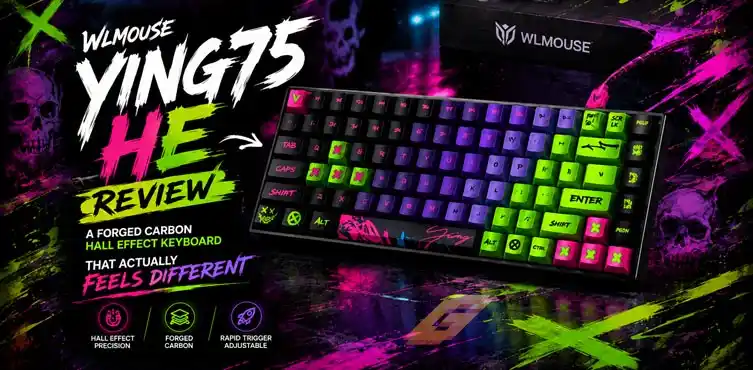

The WLMOUSE Ying75 HE is a high-performance 75% magnetic switch keyboard that pairs a luxury forged carbon fiber chassis with elite internal specs like 8,000Hz polling and 0.005mm Rapid Trigger precision. It solves the “thin” sound issues of typical gaming boards through a six-layer dampening stack and unique AG glass accents, making it a rare hybrid of enthusiast-level build quality and world-class gaming speed.
WLMOUSE Ying75 HE Review: The Forged Carbon Hall Effect Revolution
If you have been hunting for the absolute peak of keyboard performance, you have likely run into the WLMOUSE Ying75 HE. This is not just another mechanical keyboard; it is a precision instrument designed for the extreme demands of the current competitive gaming scene.
The Graffiti Limited Edition takes things even further by using materials usually reserved for hypercars and aerospace engineering. By combining forged carbon fiber with a massive 8,000Hz polling rate, WLMOUSE is targeting players who refuse to compromise between luxury aesthetics and “zero-latency” hardware.
In this review, we are going to break down every single layer of this board based on the official technical features. From the unique acoustic properties of the shell to the specialized demagnetizing hardware, here is exactly why the Ying75 HE stands apart from the crowd.
Is the WLMOUSE Ying75 HE the fastest gaming keyboard available?
Yes, the WLMOUSE Ying75 HE is among the fastest keyboards in existence because it combines a native 8,000Hz polling rate with a staggering 32,000Hz internal scan rate. This allows for an ultra-low latency of just 0.125ms, which is the current industry ceiling for wired input devices.
While many standard gaming keyboards poll at 1,000Hz, the Ying75 HE updates its status eight times faster. The internal processor checks the state of every key 32,000 times a second. This ensures that when the 8,000Hz “bus” arrives to collect data for your PC, the keyboard has the most current position of your switches possible.
In high-stakes shooters like Valorant or Counter-Strike 2, this eliminates the tiny micro-delays that can occur between your finger moving and the game registering a counter-strafing command. You are getting the most accurate representation of your physical movement translated into digital action.
How does the Ying75 HE compare to other high-end HE keyboards?
The WLMOUSE Ying75 HE differentiates itself from competitors through its exotic forged carbon construction and higher 32k internal scan rate. While the Wooting 80HE is often cited for having a more mature software ecosystem and the Keychron Q1 HE offers broader accessory availability with its aluminum build, neither provides the specific vibration-dampening properties of the Ying75 HE’s carbon shell.
If you value a refined, marbly sound signature right out of the box, the WLMOUSE has a distinct edge. The Wooting remains the king of “set it and forget it” firmware, but the Ying75 HE is built for the user who wants a piece of industrial art that doubles as a competitive tool.
What makes a forged carbon fiber shell better than aluminum?
A forged carbon fiber shell provides superior vibration absorption and a higher strength-to-weight ratio than traditional CNC-machined aluminum. While aluminum is prone to high-pitched “pinging,” the composite nature of forged carbon naturally dampens resonant frequencies, resulting in a deeper, more refined acoustic profile.
Forged carbon is made by taking thousands of small carbon fiber fragments and compressing them with resin under immense pressure. This creates the unique, marbled “Graffiti” look where no two keyboard cases are exactly alike.
Beyond the looks, carbon fiber is incredibly stiff. When you are typing at 120 words per minute or mashing keys during a clutch play, you won’t feel any chassis flex. This rigidity gives the gasket-mounted internals a stable “launchpad,” making every keypress feel more intentional and consistent across the entire 75% layout.
Addressing the Top 3 User Feedbacks
Based on current community feedback and technical limitations in the Hall Effect (HE) space, the WLMOUSE Ying75 HE directly addresses three critical issues:
- The “Mainstream Gaming” Sound: Most high-speed boards sound hollow or “clacky.” The Ying75 HE uses a specialized six-layer stack of Japanese Inoue Poron and silicone to create a deep, premium sound.
- Magnetic Sensor Drift: Rapid Trigger sensors are often sensitive to temperature and nearby metal. WLMOUSE uses demagnetizing screws to keep the magnetic field around the sensors clean and consistent.
- Thread Durability: Many exotic material cases use plastic threads that strip easily. The Ying75 HE uses internal brass standoffs to ensure you can take the board apart for cleaning or modding without ever ruining the chassis.
Engineering the Perfect Sound: The Six-Layer Acoustic Stack
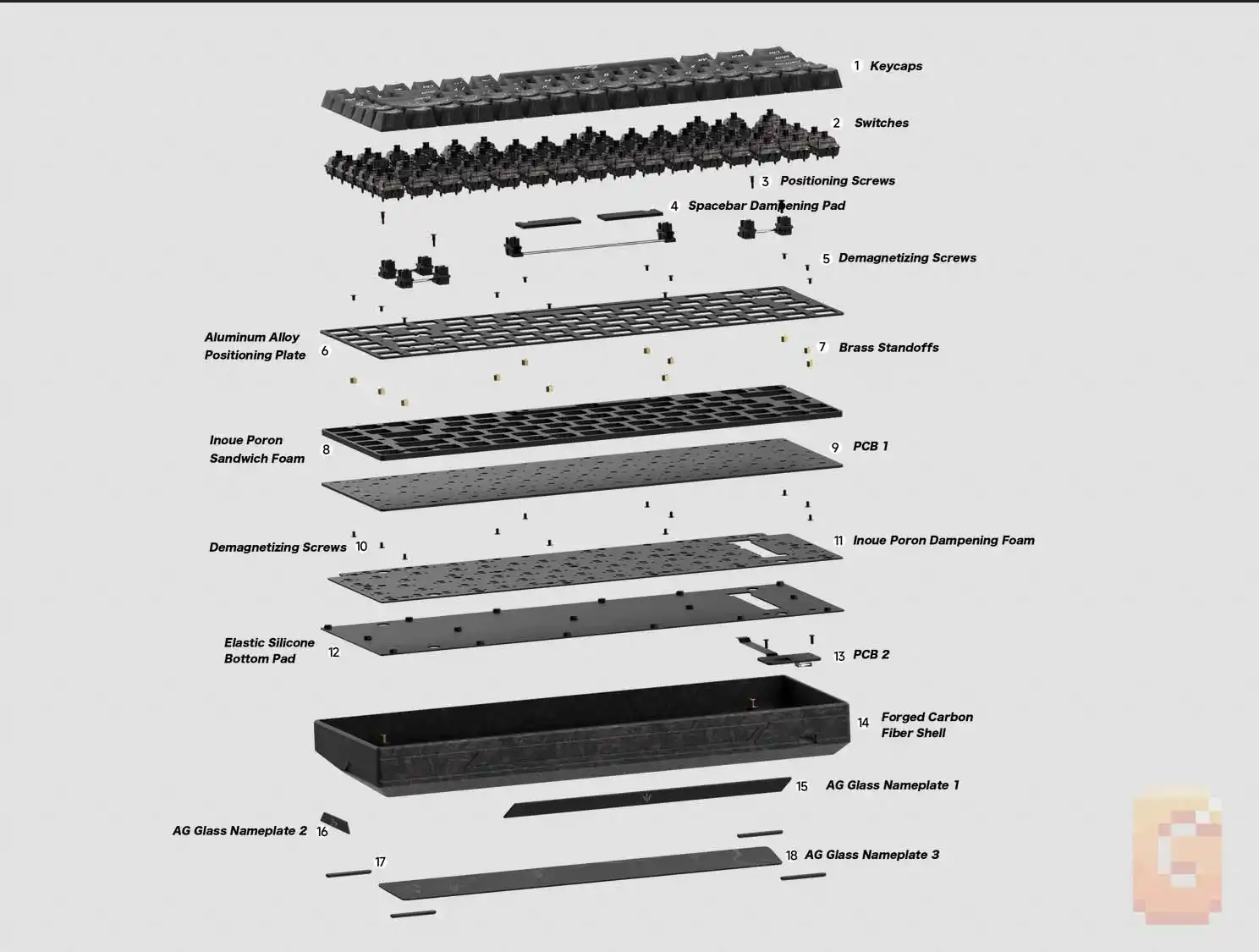
The WLMOUSE Ying75 HE uses a sophisticated dampening system to eliminate the thin, “pingy” noise common in competitive peripherals. While most mainstream gaming keyboards ship with minimal acoustic dampening, if any, the Ying75 HE uses six distinct layers of Poron and silicone to focus the sound of the custom switches.
You can actually see the engineering intent in the internal stack:
- Inoue Poron Sandwich Foam: This sits directly between the plate and the PCB to kill high-frequency vibration at the source.
- Aluminum Alloy Positioning Plate: This provides a crisp, metallic “pop” on the bottom-out without the harshness of steel.
- Elastic Silicone Bottom Pad: This acts as the final floor for the sound, catching any remaining echoes before they can bounce off the carbon floor.
The Physics of Inoue Poron
Inoue Poron is a specialized high-density microcellular polyurethane foam produced in Japan. Unlike cheaper open-cell foams, Poron has a very consistent structure that doesn’t collapse over time.
In the WLMOUSE Ying75 HE, this material is used for both the “Sandwich” foam and the “Dampening” foam. By eliminating the air gap between the plate and PCB, it prevents vibrations from bouncing through the board’s internal cavities before escaping the case. This forced absorption is what creates that highly-coveted “thocky” sound profile.
The plate-to-PCB sandwich and the silicone bottom pad used here are the same acoustic treatment categories that custom builders apply by hand. If you want to understand why each layer targets a different resonance, how they interact with plate stiffness, and how to replicate this sound signature in a fully custom 60% build, our keyboard build and modding guide covers the complete physics — from the tape mod and PE foam all the way through advanced stabilizer tuning with the Holee mod.
Who is the WLMOUSE Ying75 HE actually for?
The WLMOUSE Ying75 HE is designed for three specific types of keyboard users who are looking for a significant upgrade over standard retail boards.
- The Competitive Tactical Shooter: If your primary focus is Valorant, CS2, or Apex Legends, the 0.005mm RT precision and 8k polling provide the lowest possible input lag. This board is for the player who wants every hardware advantage available in 2026.
- The Enthusiast Collector: If you appreciate high-end materials like forged carbon and AG glass, this limited edition Graffiti version is a collectible piece of hardware. It’s for the user who values a unique aesthetic that stands out from the sea of black aluminum boards.
- The Hybrid Professional: For those who work and game at the same desk, the 75% layout provides the necessary function row and arrow keys for productivity. The premium PBT keycaps and deep acoustic profile make it comfortable for 8-hour workdays while remaining a beast for after-hours gaming.
Luxury Aesthetics: The AG Glass Nameplates
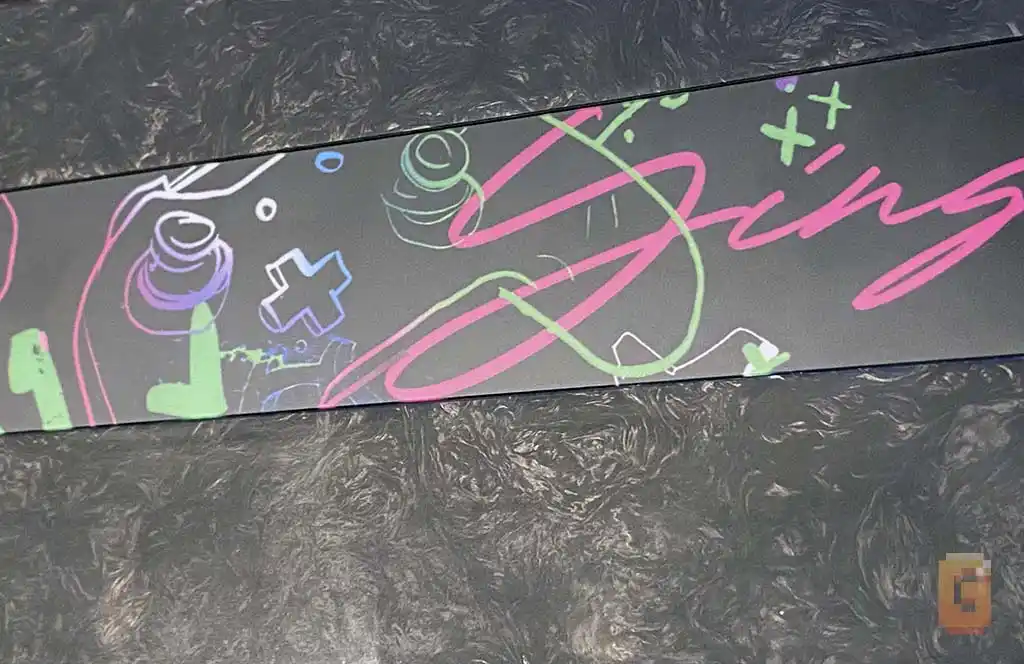
The WLMOUSE Ying75 HE features three AG (Anti-Glare) glass nameplates that serve as chemically etched, fingerprint-resistant accents. These components (numbered 15, 16, and 18 in the schematic) are incredibly rare in the keyboard industry and provide a matte, high-density finish that plastic or metal badges cannot replicate.
In the “Graffiti” edition, these glass plates act as the primary canvas for the limited-edition branding. Because they are chemically etched rather than just coated, the finish will not wear off or become shiny with contact. This contributes to the overall premium feel of the board and helps set it apart from mass-produced plastic gaming peripherals.
The Hall Effect Ecosystem: 0.005mm Rapid Trigger Precision
How does the WLMOUSE Ying75 HE achieve such industry-leading movement control? It uses high-sensitivity Hall Effect sensors on the PCB that can detect key travel distances as small as 0.005mm, allowing for instantaneous Rapid Trigger resets.
Magnetic switches don’t have metal leaves that touch. Instead, a sensor measures the distance of a magnet inside the switch stem. This allows you to customize exactly where a key activates.
You can set your “W” key to be hyper-sensitive (0.10mm) for instant movement, while setting your “G” or “Ultimate” key to 2.0mm to prevent accidental triggers. This level of granular customization is why Hall Effect technology is rapidly becoming the gold standard for pro-tier gaming.
Understanding Polling Rate vs. Scan Rate
One of the most confusing parts of the WLMOUSE Ying75 HE specs is the difference between the 8,000Hz polling rate and the 32,000Hz scan rate. To put it simply: the scan rate is how fast the keyboard talks to itself, and the polling rate is how fast the keyboard talks to your computer.
If your keyboard only scanned at 1,000Hz but polled at 8,000Hz, you would just be sending the same “old” data eight times in a row. By scanning at 32,000Hz, the Ying75 HE ensures that every time your PC asks for data, the keyboard has a fresh, up-to-the-millisecond update on exactly where your keys are.
This architecture reduces “latency variance,” or what some gamers call input jitter. By having a scan rate 4x higher than the polling rate, the hardware ensures that the “latest” magnetic measurement is always ready to go the moment the USB polling interval fires.
The Hidden Advantage: Why Demagnetizing Screws Matter
Why did WLMOUSE include demagnetizing screws in the Ying75 HE assembly? Standard steel screws can develop a small magnetic charge over time, which interferes with the delicate Hall Effect sensors and causes “phantom” keypresses or inconsistent actuation points.
This is a detail most brands ignore. By using specialized non-magnetic hardware (shown as components 5 and 10 in the diagram), the board maintains a “clean” electromagnetic environment. For a keyboard that relies on 0.005mm magnetic sensitivity, this isn’t just a luxury—it’s a requirement for consistent performance.
You’ll also notice the use of Brass Standoffs (Component 7). Because the carbon fiber shell is a composite, you can’t just screw directly into it forever. The brass standoffs provide a durable metal-on-metal connection, ensuring the board stays tightly sealed even if you decide to swap your plate or foam layers down the line.
High-End Switches: Nightfall and Shadow Customs
The WLMOUSE Ying75 HE offers two custom-tuned switch options: Gateron Nightfall or TTC Shadow. Both are factory-lubed, linear magnetic switches with a contactless design that is rated for over 100 million keystrokes.
Because there is no physical friction between metal contacts, these switches feel incredibly smooth. You won’t feel the “scratchiness” often found in budget mechanical keyboards.
The keycaps are equally premium. They use a hybrid of frosted transparent polycarbonate (PC) on the sides to let the RGB glow through, and side-engraved PBT double-shot on the tops. PBT is much more durable than the ABS plastic found on most pre-builts, meaning the keys won’t get “shiny” or oily after months of use.
Mounting Strategy: The Gasket Mount Feel
The WLMOUSE Ying75 HE uses a “Gasket Mount” structure, which means the internal assembly—the plate and the PCB—is cushioned between pieces of silicone or Poron.
If the concept of gasket mounting is new to you, we have a comprehensive keyboard modding guide that walks through exactly how gaskets physically suspend the plate away from the hard case walls, why that isolation changes both the sound and the typing feel, and how it compares to tray-mount designs like the original KBDfans Tofu60. Understanding the mechanics behind the mounting system makes the Ying75 HE’s typing character — that subtle springiness on every keypress — far easier to appreciate.
In a traditional tray-mount board, the PCB is screwed directly into the bottom case, creating “hard spots” that feel stiff and sound inconsistent. In a gasket mount, the internals “float.”
When you bottom out a key on the Ying75 HE, you’ll feel a slight rebound rather than a jarring shock to your fingers. This reduces typing fatigue and ensures that a key pressed on the edge of the board sounds just as good as a key pressed in the center.
Final Performance Verdict
The WLMOUSE Ying75 HE is a masterclass in modern keyboard engineering. It takes the “performance at all costs” mindset of a gaming peripheral and marries it to the “sound and feel” obsession of the custom keyboard hobby.
If you are a competitive player, the 8k polling and 0.005mm RT precision provide a physical advantage that you can actually feel in-game. If you are a typist or a collector, the forged carbon shell and Inoue Poron dampening provide an acoustic experience that most “gaming” brands simply cannot match.
It is a specialized, limited-edition tool that proves you don’t have to sacrifice build quality to get the fastest switches on the market.
If you’re choosing between the Ying75 Cyber Graffiti and other Hall Effect options, our Ying75 CG vs Tofu60 HE vs Holy60 HE comparison lays out exactly how they differ in build, feel, and value.
WLMOUSE Ying75 HE Features
- Chassis: CNC Forged Carbon Fiber with a unique marbled finish.
- Speed: 8,000Hz polling rate and 0.125ms ultra-low latency.
- Precision: 32,000Hz internal scan rate with 0.005mm RT resolution.
- Acoustics: 6-layer dampening stack featuring Japanese Inoue Poron.
- Hardware: Demagnetizing screws and brass standoffs for maximum reliability.
- Customization: Full RGB underglow and hot-swappable magnetic switches.
FAQ
Is the WLMOUSE Ying75 HE hot-swappable and can I use mechanical switches?
Yes, the Ying75 HE is fully hot-swappable, but only for magnetic Hall Effect (HE) switches. You can swap between different HE brands like Gateron or TTC, but standard 3-pin or 5-pin mechanical switches are not compatible with the Hall Effect PCB architecture.
Does 8,000Hz polling work on all computers?
While 8,000Hz is supported by Windows, it is very CPU-intensive. You will need a modern processor (Ryzen 5000/Intel 12th Gen or newer) to use the full 8k polling rate without experiencing framerate drops or stuttering in-game.
What is the difference between the Nightfall and Shadow switches?
The Nightfall switches (Gateron) typically have a slightly heavier bottom-out feel compared to the Shadow (TTC) switches. Both are linear and factory-lubed, but Nightfall is generally preferred by those who want a more substantial, resistance-heavy keypress.
How do I clean the Forged Carbon shell?
Forged carbon is very durable. Use a damp microfiber cloth with a small amount of water or a specialized electronics cleaner. Avoid harsh solvents like acetone, as they can damage the resin finish and structural integrity over time.
Is the Rapid Trigger sensitivity adjustable?
Yes, you can customize the Rapid Trigger and actuation points for every individual key via the WLMOUSE software. This allows you to set different sensitivities for movement keys (like WASD) versus utility or ultimate keys.
What is the benefit of the AG Glass nameplates?
AG (Anti-Glare) glass is chemically etched to provide a matte finish that is highly resistant to fingerprints. Unlike plastic, it provides a luxury visual element and a high-density feel that complements the forged carbon chassis.
Deciding between the Ying75 and the Wooting 80HE? We compare them head-to-head across layout, materials, software, and real total cost.
References and Technical Data:
Official WLMOUSE Product Support and Specifications
Rogers Corporation: PORON Polyurethane Foam Datasheets for Acoustic Dampening
Gateron Official: Hall Effect (HE) Magnetic Switch Technical Overview

It’s refreshing to see a ‘gaming’ keyboard finally take acoustics and build materials as seriously as raw performance. Most HE boards sound like cheap plastic, but the deep dive into the six-layer Poron stack and the benefits of forged carbon really shows why this is in a league of its own. The mention of demagnetizing screws was a great catch—that’s the kind of technical detail that makes Geeklands my go-to for reviews!
Thank you!