Single Rail vs Multi Rail PSU Explained


Single-rail and multi-rail power supplies deliver the same performance. The biggest difference is how over-current protection is managed, not speed or FPS. For most gaming PCs, either design works perfectly when the PSU itself is high quality.
Many people worry that choosing the wrong rail type will affect gaming performance or overclocking. In reality, that’s one of the biggest myths surrounding power supplies.
Modern PSU discussions often become confusing because terms like single rail, multi rail, OCP, ATX 3.1, and 12V-2×6 are thrown around without much explanation. This guide offers a straightforward answer to one of the most common questions pc builders ask: single-rail vs. multi-rail PSU. It explains what a PSU rail actually is and whether rail type affects performance.
What Is a PSU Rail?
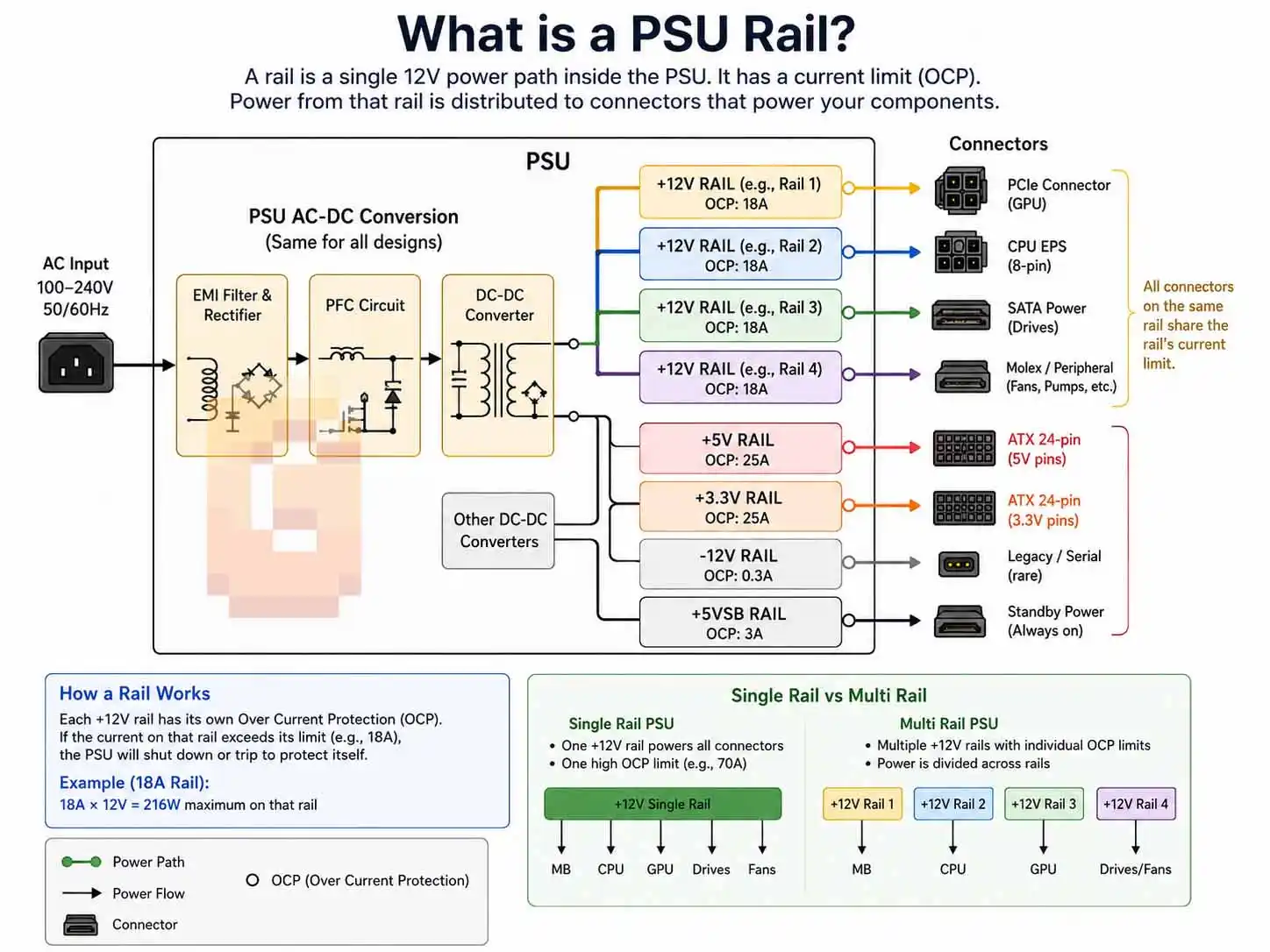
A PSU rail is simply a power delivery path inside a power supply. Most discussions focus on the +12V rail because it powers the CPU, graphics card, and other demanding components.
Think of a rail as a source of electrical current. Some PSUs deliver all +12V power through one rail, while others divide it into several protected sections. Once that +12V power reaches the motherboard, a second conversion stage takes over — the voltage regulator modules. VRMs step the incoming voltage down from 12V to the precise, lower voltages the CPU actually needs, adjusting in real time as workload intensity changes. The quality of that conversion stage is what makes motherboard power delivery just as important as the PSU itself. Our guide to what a VRM heatsink does explains how VRMs work, why they generate heat under load, and what to look for in a motherboard’s power delivery design before you buy. Understanding this makes the single vs multi rail debate much easier.
Why the +12V Rail Matters
Modern PCs rely heavily on +12V power. The CPU, GPU, fans, and many components draw power from it. That’s why most discussions about PSU rails focus almost entirely on the +12V section.
Single Rail vs Multi Rail: The Real Difference
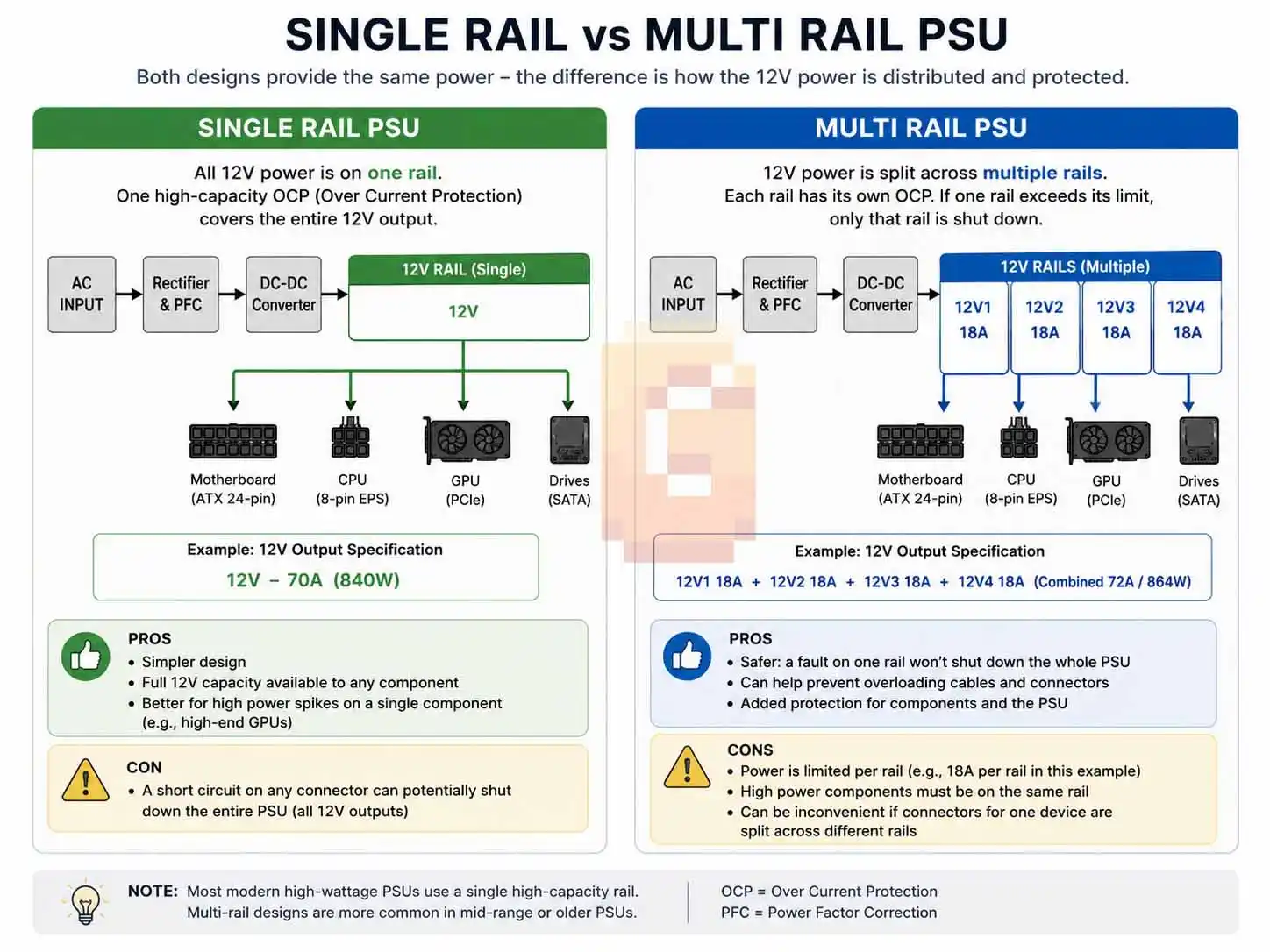
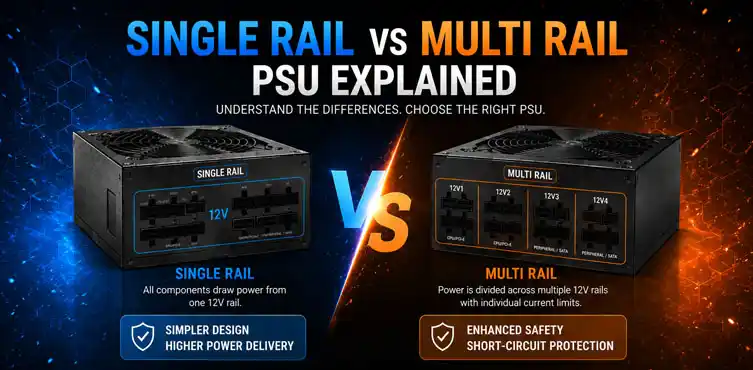
The real difference is over-current protection, not performance. A single-rail PSU supplies power through one +12V rail. A multi-rail PSU divides that output into multiple rails with separate over-current protection limits.
Neither design is faster.
Neither provides more FPS.
A quality PSU matters far more than the number of rails.
Single Rail PSU
Single-rail designs provide one large +12V power source for all components.
Advantages:
- Simpler design.
- No need to worry about load balancing.
- Less chance of triggering individual rail limits.
Potential downside:
- In the event of a fault, a larger amount of current may be available before protection activates.
Multi Rail PSU
Multi-rail designs divide the +12V output into several protected rails.
Advantages:
- Additional layer of over-current protection.
- Better isolation during certain fault conditions.
Potential downside:
- Some configurations can require attention to connector distribution.
Does Single Rail Provide Better Performance?
No. Single rail and multi rail PSUs perform the same. Gaming performance, rendering speed, and overclocking results are determined by the quality and capacity of the power supply, not by the rail layout.
A single-rail PSU does not provide more FPS. Multi-rail PSUs do not reduce performance. Rail design affects protection behavior, not computational speed.
Single Rail PSU for Overclocking: Myth or Reality?
It’s mostly a myth.
Some enthusiasts have historically preferred single-rail units because they eliminate concerns about individual OCP limits. However, a well-designed multi-rail PSU can support heavy workloads and overclocking just as effectively.
Virtual vs Physical Multi Rail: What Most Guides Don’t Tell You
Most “multi-rail” PSUs today are actually virtual multi-rail designs. Instead of having several completely separate physical +12V circuits, they usually have one physical +12V source with electronic current sensing that creates multiple protected rails.
This distinction is rarely explained in mainstream guides.
Physical Multi Rail
True physical multi-rail designs separate current distribution into distinct circuits. These are less common today.
Virtual Multi Rail
Virtual multi rail uses one physical +12V source and applies over-current protection at multiple sensing points. For many users, the safety advantages remain while maintaining simpler internal power delivery.
Does It Still Matter with ATX 3.1 and Modern GPUs?
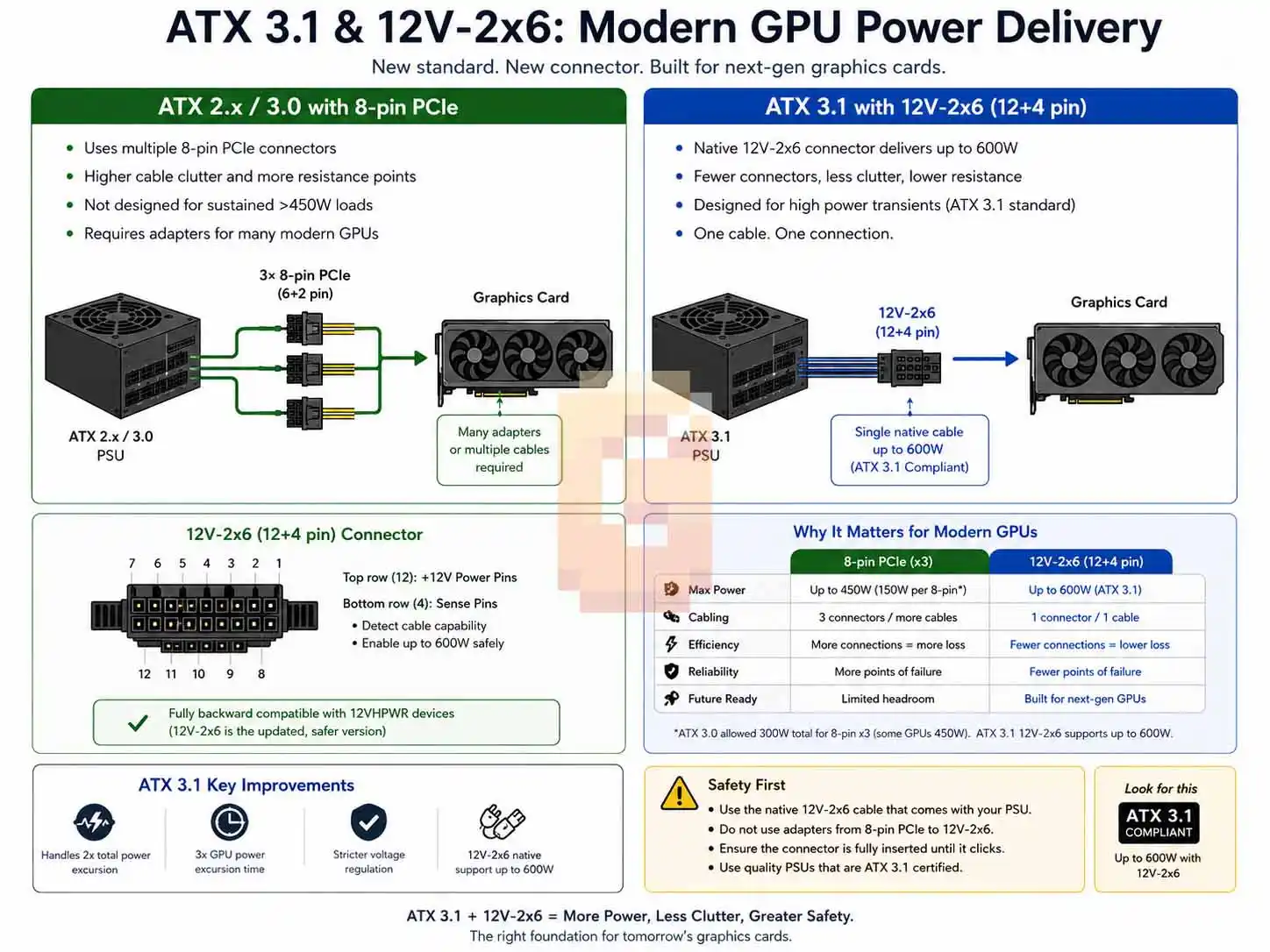
Not much for typical gaming systems. Modern ATX 3.1 power supplies and native 12V-2×6 connectors are designed to support very demanding graphics cards and large transient loads. This makes the quality of the PSU more important than whether it uses a single rail or multiple rails.
For most builders, the debate simply isn’t a deciding factor anymore.
PSU Rail ATX 3.1 and 12V-2×6 Context
Modern GPUs can draw significant bursts of power. ATX 3.1 and native 12V-2×6 connectors are designed with these workloads in mind. When choosing a power supply for current-generation graphics cards, overall PSU quality, wattage, and compliance matter far more than rail count.
Wattage headroom becomes most critical at the top of the GPU stack, where next-generation flagships are expected to maintain or exceed current power demands. If you’re planning a build around what’s coming from NVIDIA’s Rubin architecture, our breakdown of whether the RTX 6090 will be better than the RTX 5090 is worth reading alongside your PSU research — it covers flagship upgrade timing, what Feynman’s platform-level changes could mean, and why power delivery planning matters more at this tier than anywhere else.
ATX 3.1 introduced a requirement that PSUs support transient power spikes up to 200% of rated power for short durations (around 100 microseconds), which directly addresses the power delivery demands of cards like the RTX 4090 and 5090 with their 12V-2×6 connectors.
Practical Scenario Where Rail Type Can Matter
For most gaming PCs, rail configuration isn’t something you’ll ever notice. However, there is one situation where it can matter. A very high-power graphics card combined with a multi-rail PSU may require attention to how the PCIe or 12V-2×6 cables are distributed across the available rails.
If too much current is concentrated on one rail, its over-current protection (OCP) could activate even though the power supply itself has enough total capacity. This is one reason some enthusiasts have historically preferred single-rail units, since a single rail removes concerns about balancing loads. Modern power supplies and virtual multi-rail implementations have reduced this issue considerably, but builders using extremely demanding GPUs should still consult the PSU manual to understand connector and rail assignments.
This is also worth keeping in mind if you’re planning to enable AMD’s Precision Boost Overdrive. PBO lets a Ryzen CPU automatically draw more power whenever thermal and electrical headroom allows — which means your PSU, its rail configuration, and your motherboard’s VRM are all part of the same chain PBO depends on. Our guide to AMD PBO explained covers how much of a difference your power delivery setup actually makes when enabling it, what PPT, TDC, and EDC limits mean in practice, and whether your cooler is up to the task.
FAQ
Does a single rail PSU give more FPS?
No. FPS is unaffected by rail design. Performance depends on the hardware and overall PSU quality.
Is multi rail safer?
Yes. Multi-rail designs provide additional over-current protection. Many modern implementations are virtual multi-rail systems.
How do I know if my PSU is single rail or multi rail?
Check the PSU label, product manual, manufacturer website, software, or physical switches if supported.
Are most multi rail PSUs physically separate rails?
No. Many modern multi-rail units are virtual multi-rail designs using one physical +12V source and multiple protection points.
Should I care about rail type when buying an ATX 3.1 PSU?
Usually no. Overall PSU quality and ATX 3.1 compliance matter more for modern GPUs.
Conclusion
The answer to single rail vs multi rail PSU explained is surprisingly simple:
<ul”>
- Neither design affects performance.
- Rail layout mainly changes over-current protection behavior.
- Most modern multi-rail units are virtual rather than physically separate rails.
- PSU quality matters far more than rail count.
- ATX 3.1 and modern GPUs make overall design quality more important than ever.
The rail design matters much less than PSU quality, efficiency, protections, and adequate wattage. If you’re buying a quality ATX 3.1 power supply from a reputable manufacturer, either design is perfectly capable of powering a gaming PC. The virtual versus physical distinction is more interesting than the single versus multi debate itself. So, rail configuration should be a secondary consideration, not the deciding factor.
References
- Intel ATX Version 3.1 Multi-Rail Desktop Platform Power Supply Design Guide
https://www.intel.com/content/www/us/en/content-details/336521/atx-version-3-multi-rail-desktop-platform-power-supply-design-guide.html - Corsair: What You Need to Know About Single-Rail and Multiple-Rail PSU Safety
https://help.corsair.com/hc/en-us/articles/4415065357069-PSU-What-you-need-to-know-about-single-rail-and-multiple-rail-PSU-safety - Cultists Network PSU Tier List and PSU Resources
https://cultists.network/140/psu-tier-list/