Wooting 80HE vs WLMouse Ying75
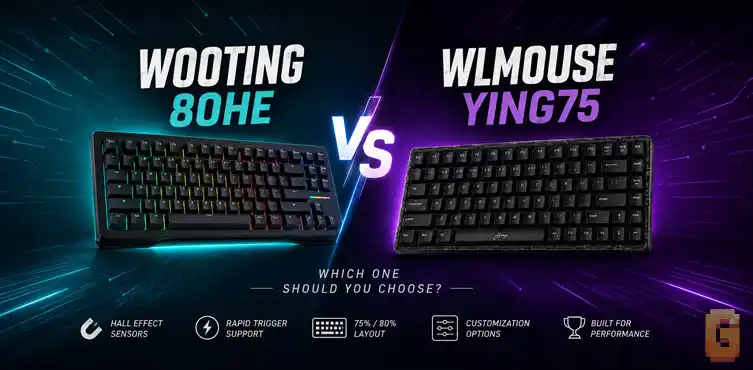

The Wooting 80HE offers the industry-leading Wootility software and a softer polycarbonate plate but is constrained by a proprietary layout and a higher fully assembled cost. The WLMouse Ying75 is a true 75% wired keyboard with a forged carbon fiber case and premium Gateron or TTC switches out of the box, presenting an excellent high-value alternative if you prefer physical modding and standard layouts over software depth.
Both keyboards promise unmatched gaming response times through magnetic analog switches and advanced rapid trigger systems. However, beneath the surface-level marketing numbers, they take vastly different paths in layout philosophy, case materials, software maturity, and total out-of-the-box cost.
If you’ve been searching for a direct Wooting 80HE vs WLMouse Ying75 comparison, you’ve probably noticed that almost nobody writes one. There are individual reviews of each board, lists of Wooting alternatives, and sound test videos — but almost no article that compares these two head-to-head in the areas that actually matter at this price point. That’s what this one does.
In this comprehensive deep dive, we break down these differences step by step. We look past the raw specifications to analyze how each keyboard functions on your setup.
Whether you are a competitive FPS player or a custom keyboard enthusiast, this analysis will help you choose the right board. Throughout this comparison, we separate verified manufacturer specifications from marketing claims that haven’t yet been independently tested. Let’s dig into the layout, construction, and actual cost of these two devices.
Layout & Case: Is the Wooting 80HE Actually a 75% Keyboard?
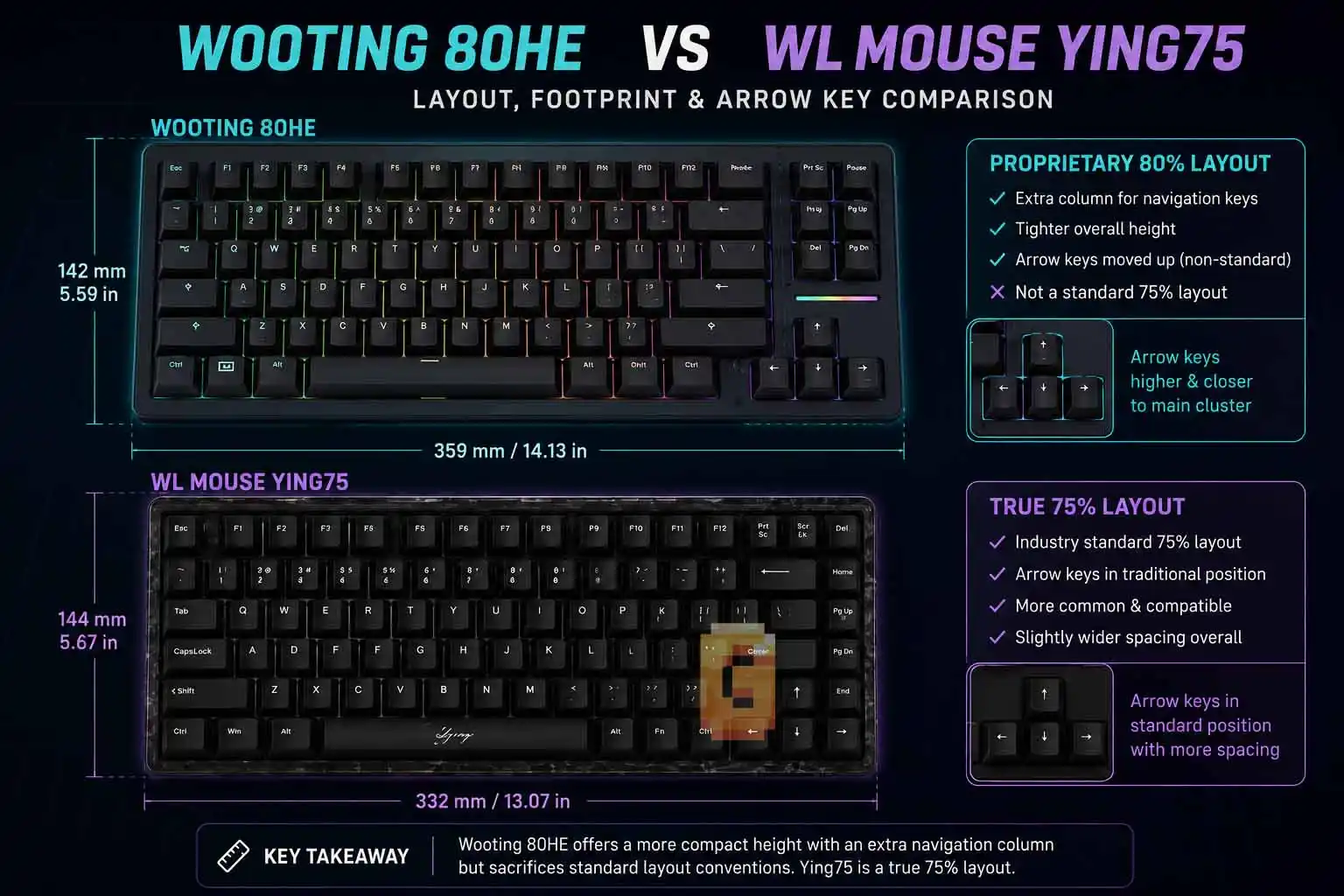
No, the Wooting 80HE is not a standard 75% keyboard, but rather a proprietary layout that sits one key-row short of a traditional tenkeyless (TKL) footprint. Because of this unique form factor, its PCB and internal module will not fit into standard aftermarket 75% keyboard cases.
This distinction is crucial if you love customizing your build. Many buyers assume they can buy the Wooting 80HE module and drop it into a third-party custom 75% aluminum case. Unfortunately, that is impossible due to Wooting’s proprietary layout.
The WLMouse Ying75, on the other hand, utilizes a true, standard 75% layout. This means it adheres to standard compact spacing, making standard keycap set installation straightforward. It also means you can swap the PCB into standard aftermarket cases down the road. If you plan to go further with case swapping, plate experiments, or switch modding, our keyboard modding guide covers what to look for before committing to a layout.
Here is a direct look at how the layouts and case designs differ:
| Feature | Wooting 80HE | WLMouse Ying75 |
|---|---|---|
| Layout Style | Proprietary “80%” (one row short of TKL) | True 75% standard compact |
| Aftermarket Case Support | No (limited to Wooting cases) | Yes (standard 75% mountings) |
| Case Options Out of Box | PCR ABS Plastic or Zinc Alloy | Forged Carbon Fiber |
If you prefer a standardized compact form factor that gives you the freedom to swap cases and enjoy standard keycaps, the Ying75 is a highly adaptable choice. If you do not mind staying within Wooting’s own case ecosystem, the 80HE’s footprint is still very desk-friendly.
Switch Tech & Materials: Polycarbonate vs Aluminum Plate Comparison
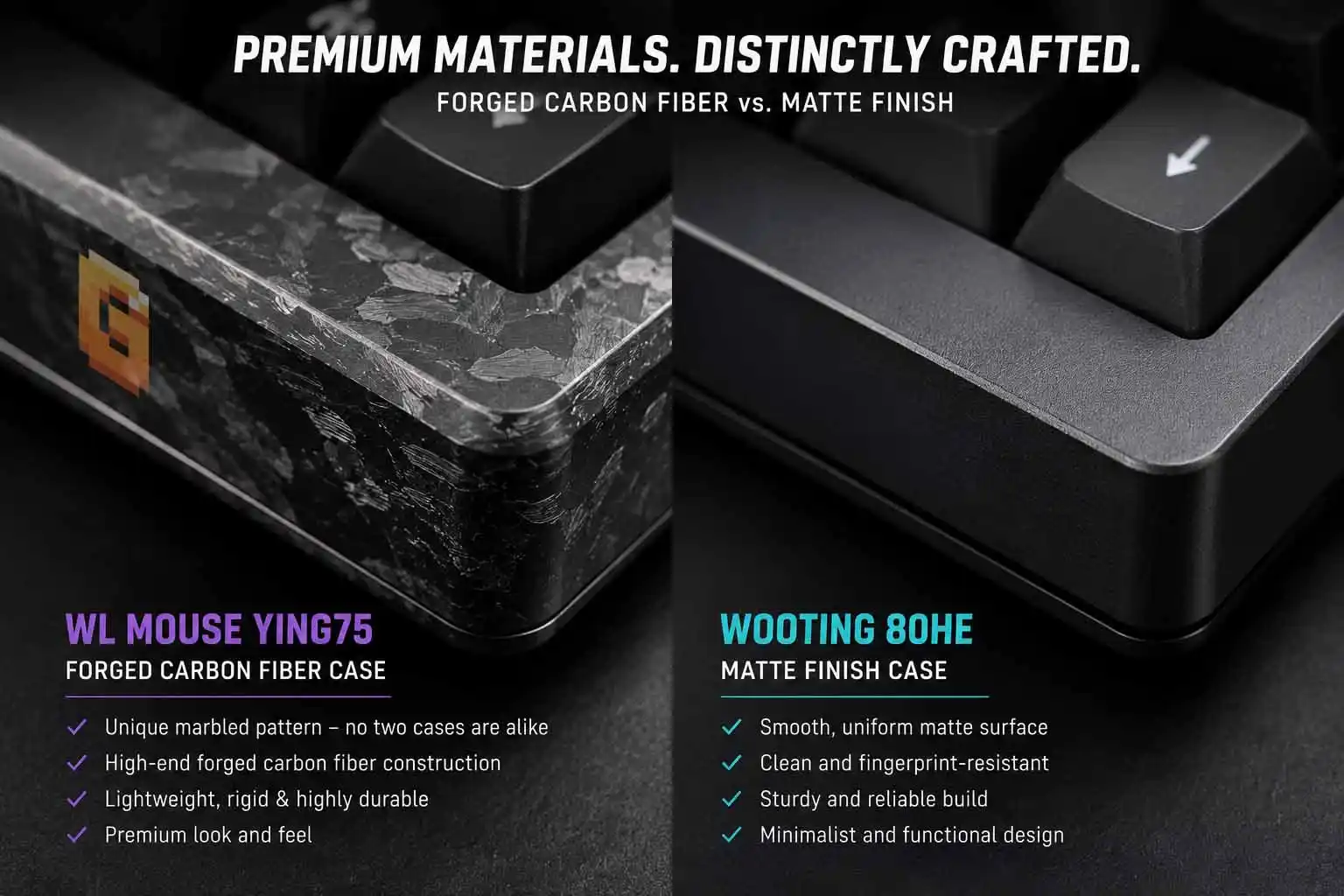
The Wooting 80HE utilizes a softer polycarbonate (PC) switch plate paired with PCR ABS plastic or Zinc Alloy cases, whereas the WLMouse Ying75 employs a rigid aluminum alloy plate enclosed in a lightweight forged carbon fiber case. This difference gives the Wooting 80HE a deeper, thockier sound profile and a softer typing flex, while the Ying75 delivers a highly rigid, crisp, and bright acoustic signature.
Sound and feel are highly subjective, but plate material plays a massive role in day-to-day comfort.
Polycarbonate plates are flexible and absorb high-frequency vibrations. This provides a damp, premium typing experience. Aluminum alloy plates, like the one inside the Ying75, are stiff and metallic. They offer an immediate, crisp bottom-out feel that many gamers prefer for feedback, though they can sound significantly clackier.
| Feature | Wooting 80HE | WLMouse Ying75 |
|---|---|---|
| Switch Plate Material | Polycarbonate (PC) | Aluminum Alloy |
| Mounting Style | Gasket mounted | Gasket mounted |
| Typing Acoustics | Dampened, deep “thock” | Rigid, metallic, bright “clack” |
| Hot-Swappable PCB | Yes (HE magnetic switches only) | Yes (HE magnetic switches only) |
Let’s look at the hotswap capability. The Wooting 80HE is fully hot-swappable, meaning you can easily swap out its stock Lekker L60 V2 switches without soldering. According to Wooting’s official specifications, the board is fully compatible with aftermarket magnetic options like Gateron Magnetic Jade or KS-20 switches. If you’re deciding whether that swap is worth it, our Wooting Lekker V2 vs Gateron Magnetic Jade Pro comparison breaks down exactly how the stock switch feels against that aftermarket option.
The WLMouse Ying75 is also hot-swappable, but it ships with custom Gateron Nightfall or TTC Shadow magnetic switches rather than the standard KS-20 series. These linear options offer a smooth 36g starting weight and a tight, low-wobble housing. This provides a highly consistent keystroke right out of the box. For a full breakdown of the Ying75’s build quality and typing feel outside this comparison, our hands-on Ying75 HE review covers acoustics, long-term feel, and real-world gaming use.
32K Scan Rate vs 8K Polling: Does It Actually Matter?
No, the 32,000Hz internal scan rate featured on the WLMouse Ying75 does not offer a competitive in-game advantage over the Wooting 80HE’s 8,000Hz polling rate. Both keyboards communicate with your PC at the exact same peak polling rate of 8,000Hz, which means they both register inputs at a lightning-fast 0.125ms delay.
Marketing numbers in the gaming peripheral space can be incredibly confusing. It is vital to separate internal switch scanning from external PC communication.
The 32K scan rate of the Ying75 means the keyboard’s internal controller checks the analog state of the magnetic sensors 32,000 times a second. However, because the USB connection is limited to 8,000Hz, your PC only receives those updates every 0.125ms anyway.
The same logic applies to Rapid Trigger precision. The Ying75 boasts a microscopic 0.005mm precision threshold, while the Wooting 80HE operates at 0.1mm.
While a twenty-fold increase sounds dramatic on paper, human fingers cannot consistently control movements at a 0.005mm scale. Physical desk vibrations, micro-shocks, or simple finger twitches can easily exceed that threshold, making such settings impractical for real-world gameplay.
Both keyboards represent the absolute pinnacle of competitive gaming response times. You will not lose a match because of a latency difference between these two boards. New entrants keep pushing these numbers further, too — our review of the ATK VELOTA FUZZY 60 V2 covers a keyboard claiming 8K polling with a 0.001mm Rapid Trigger floor, though those figures are ATK’s own specifications and haven’t been independently verified yet.
Wootility vs WLMouse Software: Day-to-Day Reality
Wooting’s Wootility remains the gold standard of Hall Effect keyboard software, providing a highly intuitive web-based interface that is incredibly robust. While the WLMouse web-based driver manages all fundamental configurations, it lacks the deep, refined custom profiling and active community ecosystem that Wooting has built over the years.
Software is how you actually interface with your keyboard’s advanced gaming features. If the software is buggy or difficult to use, the hardware’s advanced features go to waste.
Wootility is clean, fast, and does not require a bulky background installation. It handles advanced analog features, such as the Dynamic Keybinding System (DKS) and Rappy Snappy input prioritization, with incredible reliability.
The WLMouse web driver covers all the essential options you need. You can adjust your rapid trigger points, reprogram keys, set up macros, and tune RGB lighting.
However, it lacks the seamless visual guides, smooth translations, and rich community profiles found on Wooting’s site. If you enjoy deep customization, Wooting’s software ecosystem is still the clear leader.
Forged Carbon vs ABS: Build Quality and Real Total Cost
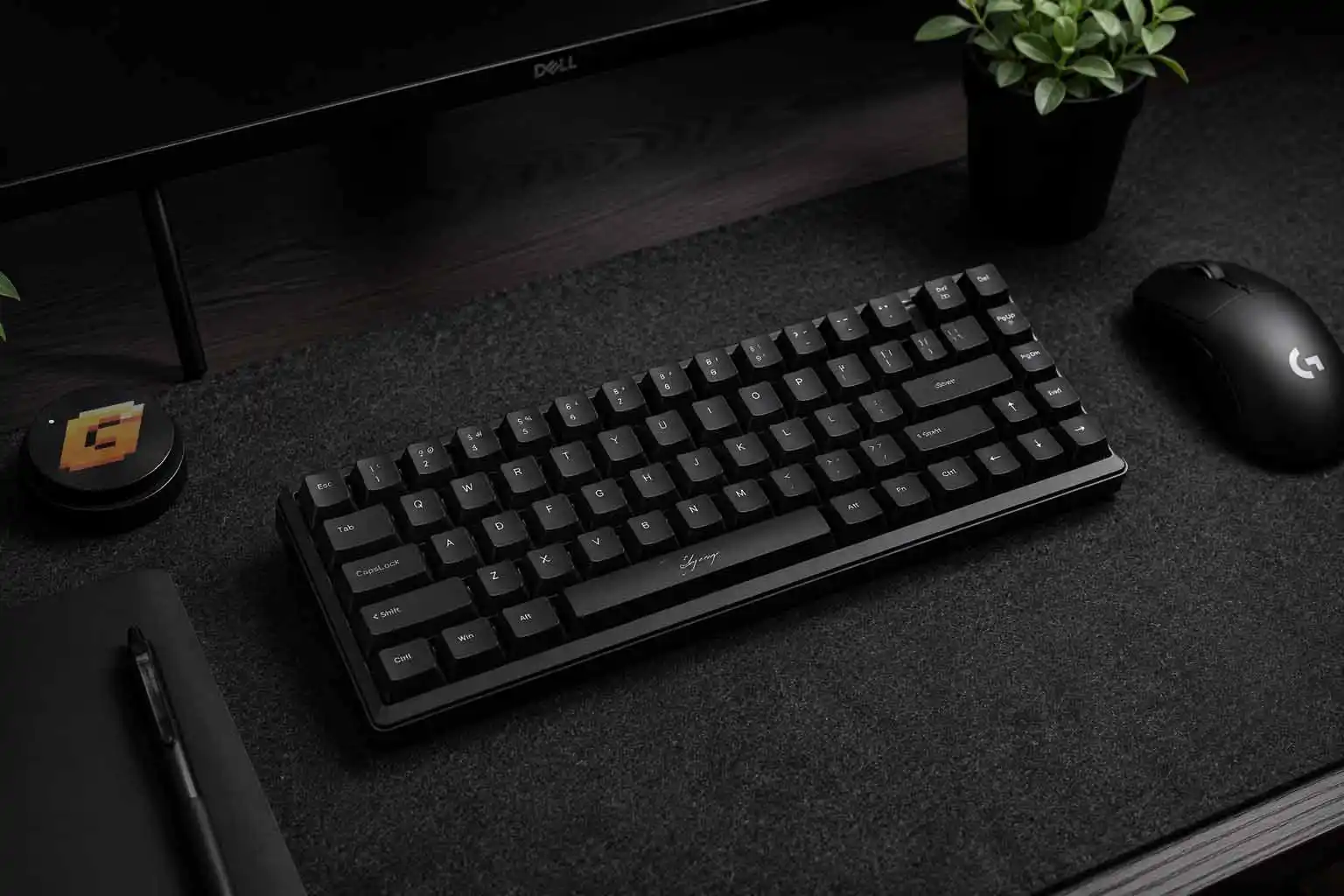
The real total cost of a fully completed Wooting 80HE with a zinc alloy case, custom switches, and keycaps sits around $380, whereas the WLMouse Ying75 costs roughly $249 all-inclusive for its forged carbon fiber case and fully assembled layout. This makes the Ying75 a vastly superior value if you want a premium, high-end design out of the box without purchasing additional parts.
When comparing prices, it is easy to be misled by the initial sticker prices. The Wooting 80HE starts around $209 as a barebone PCB or a basic plastic PCR ABS model.
To get a premium experience comparable to the Ying75’s forged carbon case, you would need to buy Wooting’s zinc alloy case, switches, and a custom set of keycaps. These additions quickly push the total price past the $350 mark.
| Cost Component | Wooting 80HE Upgrade Build | WLMouse Ying75 Complete Package |
|---|---|---|
| Base Board / PCBA | ~$209.00 (Bare module or basic plastic) | ~$249.00 (Fully assembled keyboard) |
| Premium Case Upgrade | ~$90.00 (Zinc alloy case) | Included (Forged carbon fiber case) |
| Switches & Keycaps | ~$80.00 (Lekker V2 switches + keycaps) | Included (Gateron/TTC + premium PBT caps) |
| Total Estimated Cost | ~$379.00 – $399.00 USD | ~$249.00 USD |
The Ying75’s CNC-milled forged carbon fiber case is a massive selling point. Forged carbon provides a premium, marble-like texture where no two boards look exactly identical. It is strong, extremely lightweight, and highly effective at eliminating hollow acoustic resonance.
Is the WLMouse Ying75 the Best Wooting 80HE Alternative?
Yes, the WLMouse Ying75 is currently one of the best premium alternatives to the Wooting 80HE, especially for buyers looking for standard 75% case compatibility, a unique forged carbon design, and an excellent out-of-the-box price. However, the Wooting 80HE remains the safer bet for competitive players who demand a mature, rock-solid software ecosystem and maximum custom analog profiles.
The market for high-performance analog keyboards is growing rapidly. If you are looking for an alternative to Wooting that offers high-end physical materials and a standard layout, the Ying75 is an exceptional choice. If you’re also weighing the Ying75 against other Hall Effect boards at a similar price, we put it head-to-head against the Tofu60 HE and Holy60 HE — worth reading before finalising your shortlist.
It avoids the proprietary layout limits of the 80HE, giving you true 75% freedom. The inclusion of premium Gateron Nightfall or TTC Shadow switches inside a forged carbon case at $249 makes it an incredible package.
However, Wooting’s software and firmware stability are incredibly difficult to match. Wootility has years of development and refinement behind it, which shows in competitive matches where every millisecond of input logic counts.
Ultimately, the choice comes down to whether you prioritize the hardware aesthetics and physical layout standardization of the Ying75, or the unmatched software refinement and ecosystem backing of the 80HE.
FAQ Section
Is the WLMouse Ying75 a wireless keyboard?
No, the WLMouse Ying75 is a strictly wired-only keyboard. As noted on the official WLMouse product page, it connects to your computer via a USB-C cable and does not support 2.4GHz wireless or Bluetooth.
Can I swap standard mechanical switches into the Wooting 80HE?
No, the Wooting 80HE is hot-swappable but only supports compatible magnetic (Hall Effect) switches. It is not compatible with traditional 3-pin or 5-pin mechanical switches.
Does the WLMouse Ying75 use standard keycaps?
Yes, the Ying75 uses standard Cherry profile PBT keycaps. Its true 75% layout means it is compatible with almost all standard aftermarket custom keycap sets.
What is the main structural difference between these two keyboards?
The Wooting 80HE uses a polycarbonate switch plate in a PCR ABS or Zinc Alloy case, while the WLMouse Ying75 uses a stiffer aluminum alloy plate in a forged carbon fiber case.
Conclusion
When deciding between the wooting 80he vs wlmouse ying75, the best choice comes down to which design trade-offs fit your desktop setup.
Here is a quick recap of how they compare across every key category:
- Layout: WLMouse Ying75 wins. Its true 75% layout offers standard keycap spacing and compatibility with aftermarket cases, unlike the proprietary layout of the Wooting 80HE.
- Build & Plate Feel: Tie (preference-based). The Ying75 offers a firmer, rigid typing feel with its aluminum plate. The Wooting 80HE delivers a softer, flexier, and thockier feel using its polycarbonate plate.
- Software: Wooting wins. Wootility remains the gold standard of analog keyboard software, offering unmatched polish, features, and community support compared to the basic WLMouse web driver.
- Value: WLMouse Ying75 wins. The Ying75 provides an all-inclusive package with a premium forged carbon fiber case for $249, whereas a fully custom-built Zinc Wooting 80HE setup can easily exceed $380.
- Performance: Tie. Both keyboards offer identical 8,000Hz polling rates and lightning-fast Rapid Trigger features, making any physical performance differences functionally imperceptible.
Which mattered more for you — Wooting’s software depth or the Ying75’s carbon fiber build? Let us know in the comments.
References
Wooting 80HE Official Product Page
WLMouse Ying75 Official Product Page
Digital Trends Wooting 80HE Review