Why Heat Pipes Instead of Copper? Engineering Behind Coolers



Heat pipes are used instead of simply making a much larger copper heatsink because they can move heat over a relatively long distance with far less temperature difference. The important comparison isn’t really “heat pipe vs. copper”; it is heat pipe vs. a much bigger, heavier copper block, and GPUs are one of the clearest examples of why the heat-pipe approach works so well.
What a Heat Pipe Actually Does (Briefly)
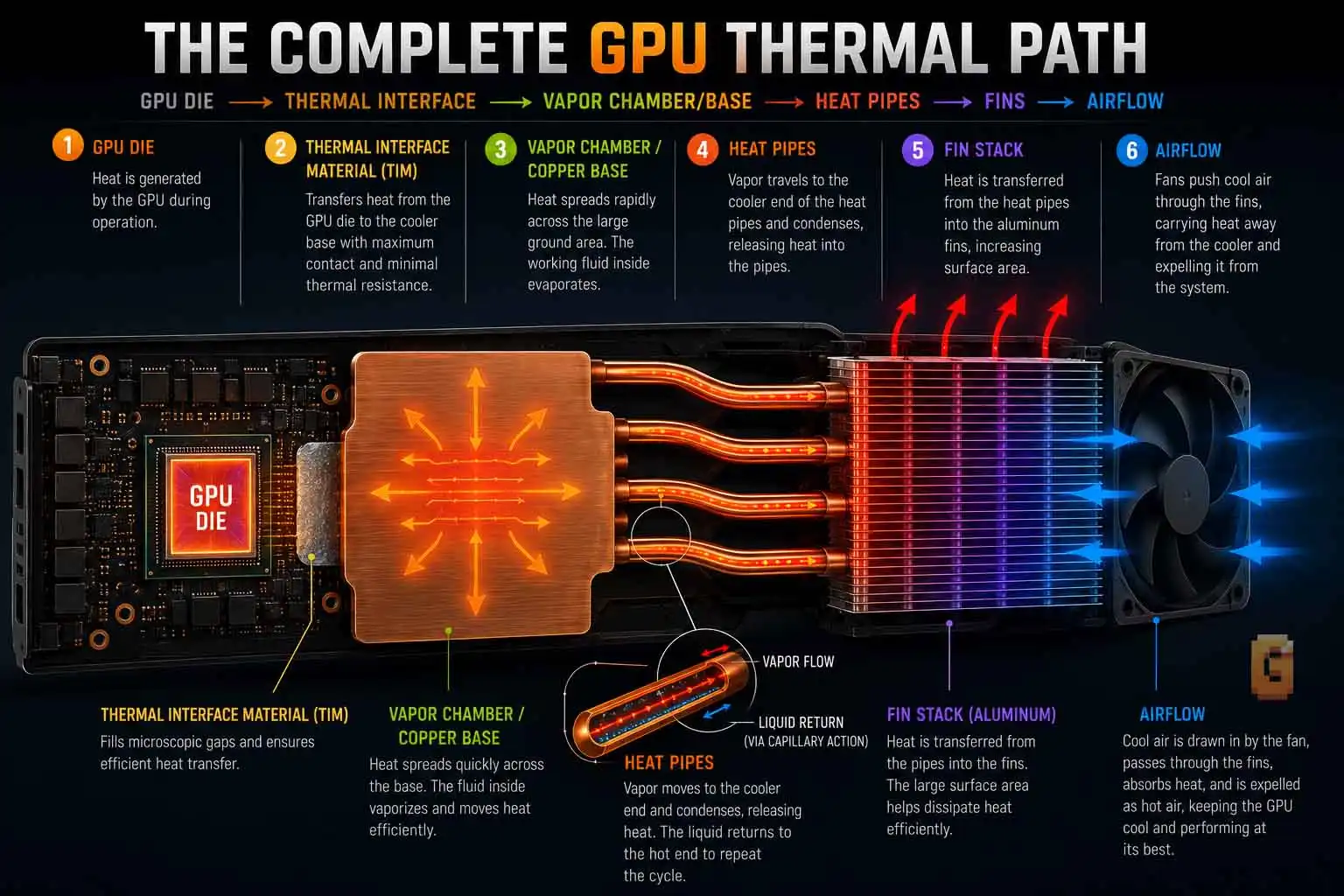
A heat pipe doesn’t magically “create” cooling. Its main job is to move heat from a concentrated hot area to a larger cooling area extremely efficiently, where fins and fans can finally dump that heat into the air.
Inside a conventional copper heat pipe is a working fluid and a wick structure. Heat applied at one end causes the fluid to evaporate; the vapor travels toward the cooler end, condenses, and the liquid returns through the wick. NASA describes this as a passive heat-transfer system that uses evaporation, condensation, and capillary action.
That distinction is important because a normal copper bar only has one way to transport heat: solid-state conduction.
Copper is already an excellent conductor. NASA gives copper’s thermal conductivity as roughly 400 W/mK, which is why copper is so common in computer coolers. But a heat pipe is exploiting a completely different physical mechanism rather than simply trying to conduct heat through more copper. This is also why the phrase “heat pipe thermal conductivity” can be confusing.
A heat pipe isn’t a homogeneous material with one fixed conductivity value in the same way copper is. Engineers often calculate an effective thermal conductivity for comparison, and that value can become extraordinarily high.
NASA documentation notes that heat pipes can have effective thermal conductivity several orders of magnitude greater than solid copper. Another NASA publication describes heat pipes as capable of effective conductivity thousands of times greater than solid silver under suitable conditions.
So the heat pipe’s real superpower isn’t that copper suddenly became better. It is that the pipe uses phase change and vapor transport to move heat.
Why Not Just Use More Copper?
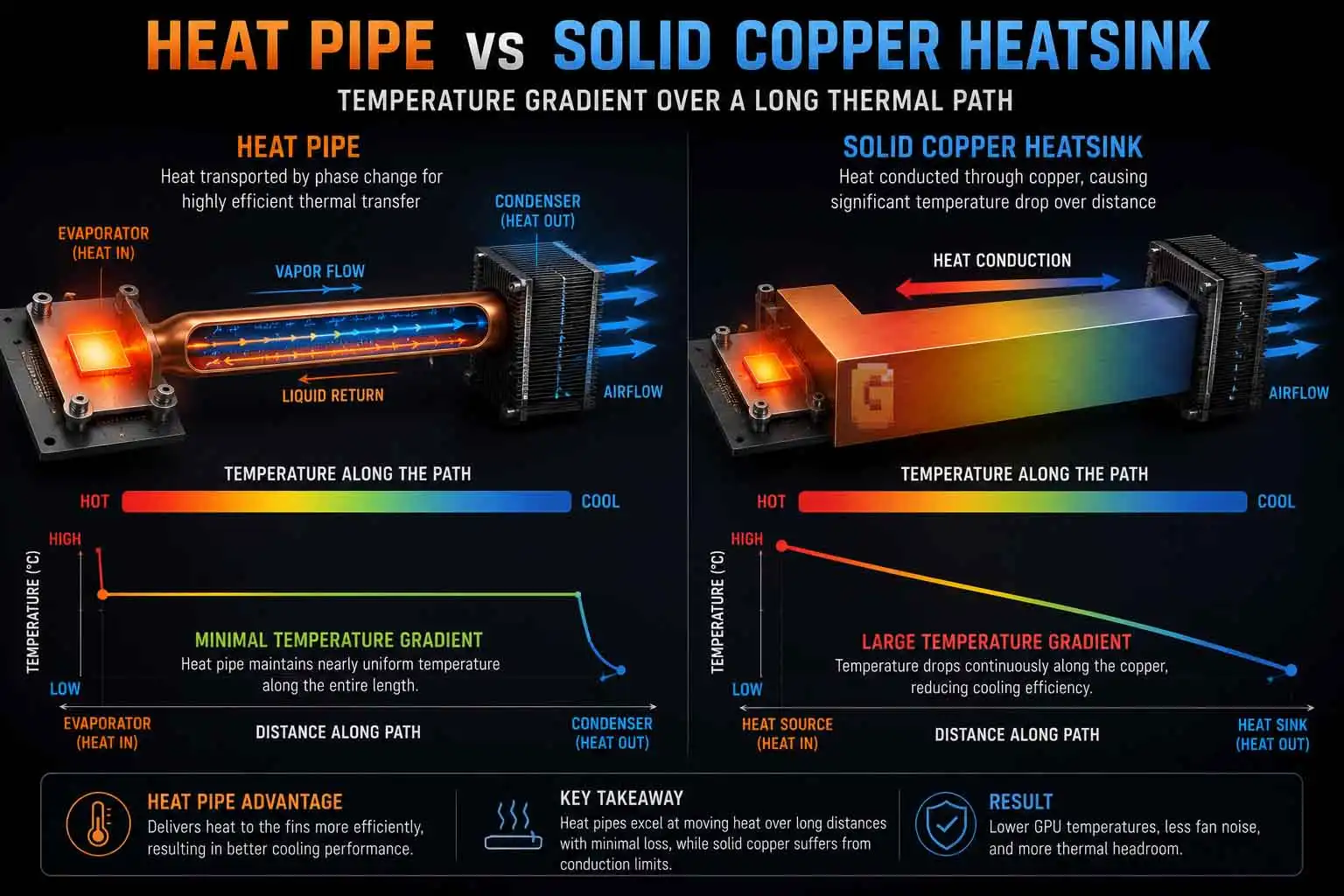
Because making the copper block bigger does not solve the underlying problem as efficiently as moving heat through a heat pipe. This is the question that makes the whole subject much easier to understand. Instead of asking, “Why isn’t the heat pipe just copper?” ask:
“Why don’t GPU manufacturers simply make the entire heatsink a huge block of copper?”
They could. The problem is that this solution quickly becomes inefficient, heavy, expensive, and physically impractical.
A bigger copper block sounds great at first
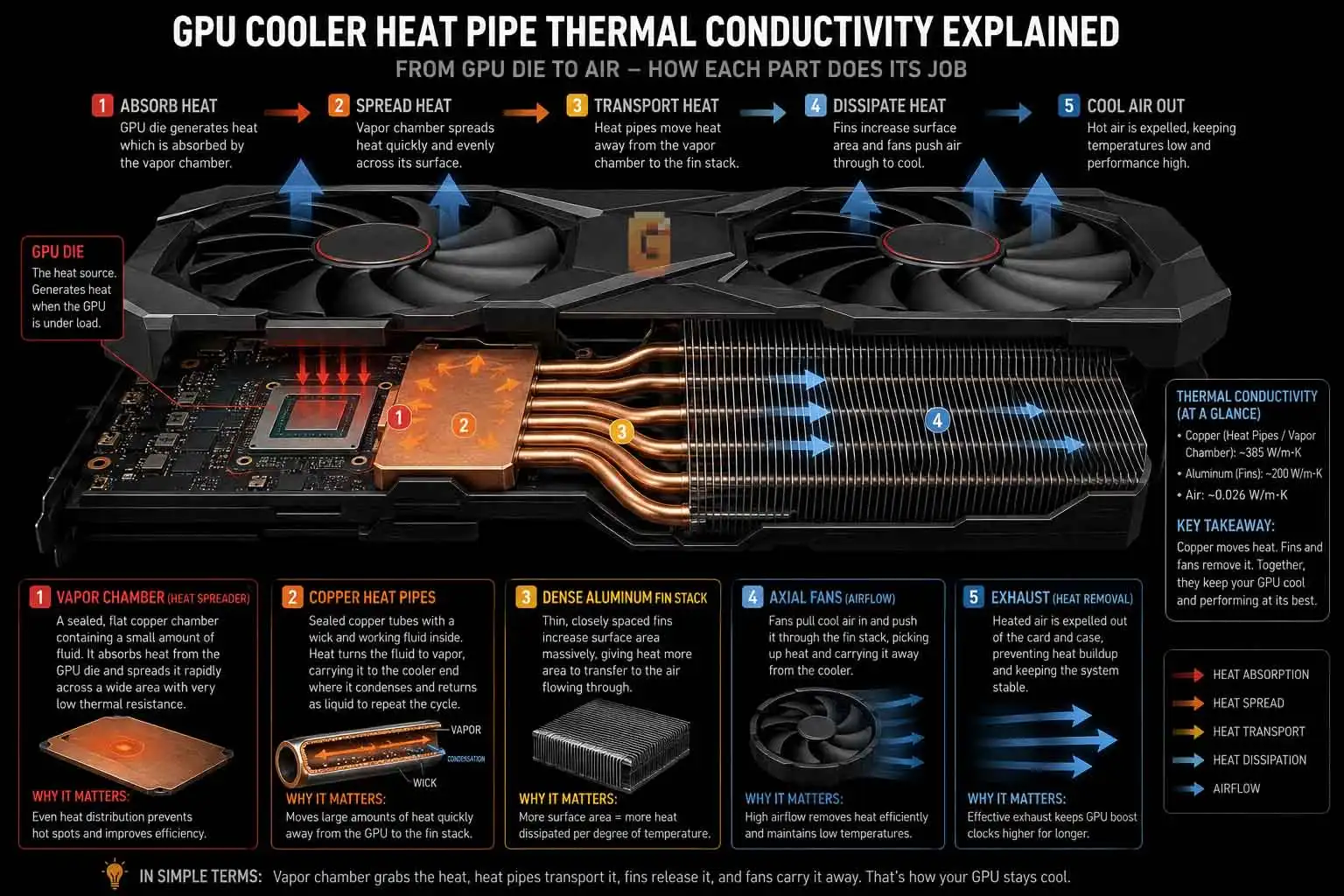
Imagine putting a solid copper block directly on top of a GPU. The GPU heats the copper, and the copper conducts that heat outward. So far, everything sounds perfect.
Now imagine the GPU is only a relatively small heat source while the heatsink is several times larger than the GPU itself. The heat has to travel from that small area through the copper until it reaches the portions of the heatsink where airflow can remove it. The longer that conduction path becomes, the more temperature difference you need to push the same amount of heat through it. That’s the fundamental limitation.
A solid copper block is therefore excellent at spreading heat over relatively short distances, but it becomes less attractive when you need to transport large amounts of heat across a longer distance. A heat pipe is specifically designed for that job.
The heat pipe separates the jobs
A modern GPU cooler effectively has two different thermal jobs:
- Get heat away from the GPU.
- Spread that heat across a large fin stack so air can remove it.
The copper base, vapor chamber, thermal interface material, and heat pipes deal with the first part. The fins and fans deal with the second. This division is extremely important.
A heat pipe doesn’t replace the heatsink. It makes it possible to put the heatsink where it is useful. That means manufacturers can place a large fin stack away from the GPU while still transporting heat efficiently from the GPU to that fin stack.
How Much Better Are Heat Pipes, Really? Reconciling the Conflicting Claims
There is no single multiplier that tells you how much better a heat pipe is than copper because effective heat-pipe conductivity depends heavily on its geometry and operating conditions. This is one of the most important details missing from many simple explanations of heat pipes.
You may encounter claims that heat pipes are tens of times better than copper, hundreds of times better, or even thousands of times better. Those numbers aren’t necessarily contradictory. They’re often describing different heat pipes, different lengths, different operating conditions, or different ways of calculating effective conductivity.
The published numbers can be enormous
Electronics Cooling notes that commonly published effective thermal conductivity figures for heat pipes can range from roughly 10,000 to 100,000 W/mK. That sounds almost absurd when copper is around 400 W/mK. But the same source specifically warns against treating those numbers as universal specifications. Heat-pipe effective conductivity can vary substantially with pipe length and other design parameters.
NASA has similarly documented heat pipes with effective thermal conductivity many times beyond ordinary metals — though the real numbers are more grounded than “thousands of times copper” once you trace them to their source.
Kenneth Burke, an electrical engineer at NASA’s Glenn Research Center, put copper’s conductivity at around 400 W/mK in a 2017 NASA Spinoff piece on heat-pipe-cooled surgical tools, and said heat pipes can reach an effective conductivity of 20,000 W/mK or more — what he called a “superhighway for heat.” That’s roughly 50 times copper. A genuinely huge jump, but nowhere near the “thousands of times” figure that sometimes gets repeated.
Separately, NASA and Advanced Cooling Technologies jointly published testing data from heat pipes flown on the International Space Station, citing effective conductivities from 10,000 to 200,000 W/m·K — hundreds to thousands of times higher than aluminum specifically, not copper. Aluminum sits around 160–200 W/mK, well below copper’s 400, so that’s a different baseline entirely. Mixing up the two is probably how inflated “thousands of times copper” claims end up circulating in the first place.
So if someone asks: “How much better are heat pipes than copper?”
The scientifically honest answer is: It depends. There is no universal multiplier.
| Material or component | Effective thermal conductivity | Source |
|---|---|---|
| Solid aluminum | ~160–200 W/mK | NASA / Advanced Cooling Technologies (ISS testing) |
| Solid copper | ~400 W/mK | NASA Glenn Research Center |
| Heat pipe — practical range for electronics cooling | ~1,500–50,000 W/mK | Celsia |
| Heat pipe — commonly published range | ~10,000–100,000 W/mK | Electronics Cooling |
| Heat pipe — NASA general figure | 20,000 W/mK or greater | NASA Glenn Research Center (Kenneth Burke) |
| Heat pipe — ISS-tested range | 10,000–200,000 W/mK | NASA / Advanced Cooling Technologies |
Why length changes the answer
This is where things get particularly interesting for PC cooling.
Suppose you have a short heat pipe. The distance between the evaporator and condenser is relatively small, so the heat pipe can move a lot of energy while maintaining a relatively small temperature difference.
Now make the pipe considerably longer. Its effective thermal conductivity can fall substantially. Electronics Cooling gives an example where a heat pipe transporting a given load has a dramatically lower effective conductivity as its length increases.
That may sound like a weakness. But for GPU cooling, it actually highlights why heat pipes are useful. The alternative is not usually a tiny piece of copper. The alternative is a long, large solid-copper conduction path. And that path has its own thermal resistance. The heat pipe can still be a much more effective way to transport the heat from the GPU to a distant portion of the heatsink.
So don’t memorize the multiplier
This is probably the most useful takeaway from the entire article:
Don’t think of a heat pipe as “100 times better than copper.” Think of it as a device whose effective heat-transport capability depends on its design, length, heat load, orientation, working fluid, wick, and operating conditions.
That is a much more useful mental model when looking at an actual GPU cooler.
Why GPUs Push This Harder Than Almost Any Other Consumer Chip
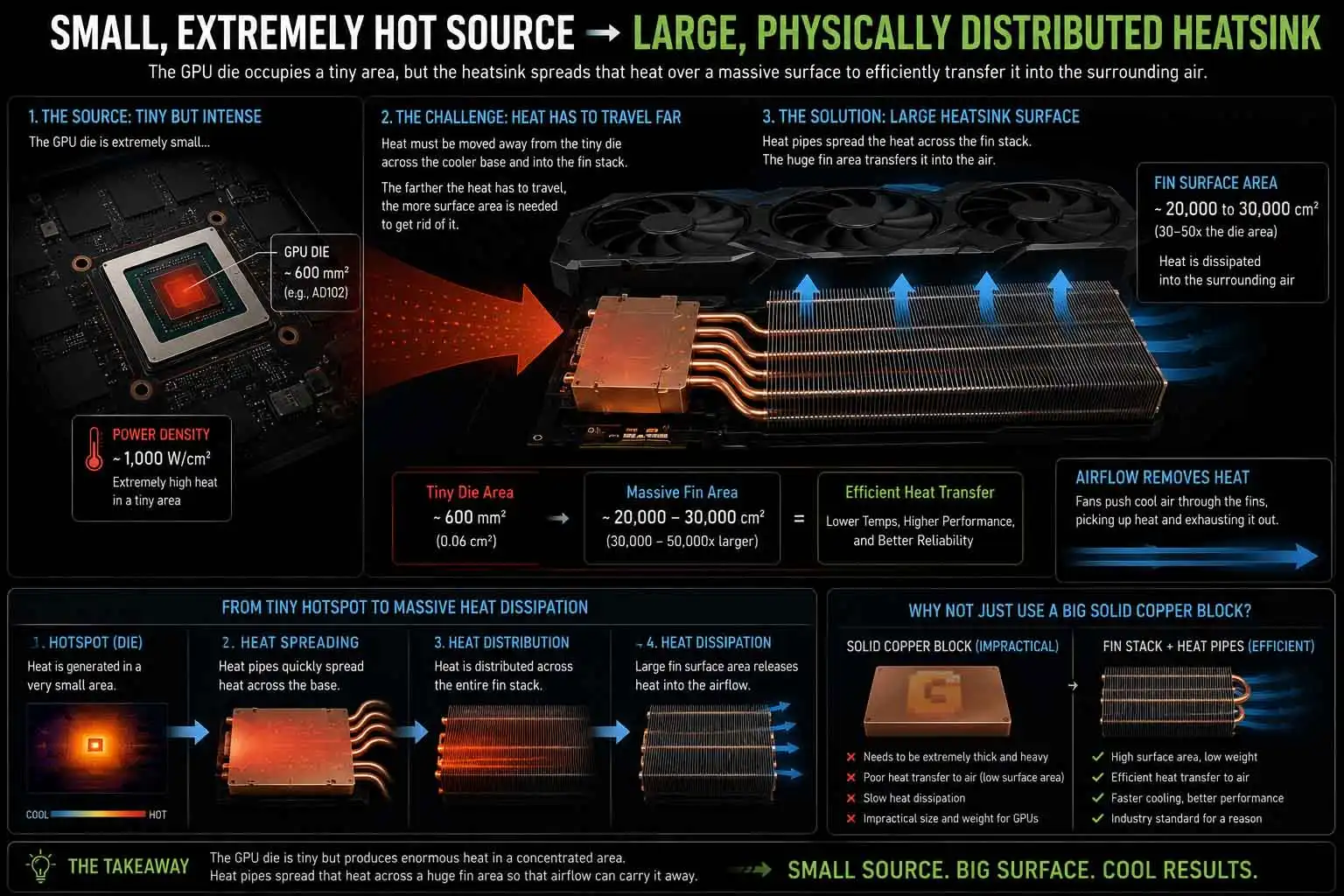
GPUs are particularly well suited to heat pipes because they combine a concentrated heat source with a large cooling structure. That’s the fundamental mismatch.
The GPU die occupies a relatively small area compared with the entire graphics-card heatsink. Yet the heatsink needs a large fin area to transfer the heat into the surrounding air. So you have something like this:
Small, extremely hot source → large, physically distributed heatsink
That is exactly the situation where efficient heat transport becomes valuable.
The GPU is small, but the cooler isn’t
Look at a large modern graphics card. The GPU itself is only one component. The cooler can span a huge portion of the card, with multiple fin stacks extending far beyond the area directly above the GPU. Fans need that large fin area because air cooling works by exposing a large surface area to moving air.
But that creates a problem. The heat generated at the GPU has to reach all those fins. You could attempt to make a gigantic copper structure connecting everything.
But now you’re dealing with a lot of copper. Copper is dense. A massive copper heatsink would increase weight dramatically, increase material cost, and create mechanical challenges for the PCB, mounting hardware, and graphics card structure.
Heat pipes let manufacturers transport heat without filling the entire cooler with solid copper. That’s the clever part. This is why GPU coolers aren’t solid metal
The answer to “why are GPU coolers not solid metal?” is therefore not simply “because heat pipes are better.” It’s because different parts of the cooler have different jobs.
You want highly conductive material near the heat source. You want efficient heat transport between separated regions. And you want an enormous amount of surface area at the final heat-rejection stage.
The optimal cooler therefore isn’t a giant copper brick. It’s a carefully engineered combination of:
- GPU thermal interface
- copper base or vapor chamber
- heat pipes
- aluminum or copper fins
- fans
- airflow channels
- structural components
For an enormous high-end GPU such as an RTX 5090, this becomes especially obvious because the cooler has to handle a large thermal load while still fitting inside the physical constraints of a graphics card.
Why Do CPUs and GPUs Use Heat Pipes?
CPUs and GPUs use heat pipes because their heat sources are concentrated while their most useful cooling surfaces are much larger and often physically separated from the chip. The basic principle is the same, but the physical implementation can differ.
CPU coolers
A desktop CPU cooler may have a relatively small contact area sitting over the CPU. Heat pipes then carry that thermal energy into a tower of fins. Once the heat reaches the fins, fans push air through them.
This allows the manufacturer to create a tall heatsink with a huge amount of surface area without putting a gigantic solid copper block directly over the CPU. That’s the heat-pipe approach to air cooling — AIO liquid coolers solve the same fundamental problem using pumped liquid instead of phase-change vapor transport. Our breakdown of AIO water cooler advantages and disadvantages covers how that alternative compares.
GPU coolers
Graphics cards take the same concept and often push it further. A GPU cooler has to fit within the width, length, and height limits of a graphics card while cooling a concentrated source.
Manufacturers can route multiple heat pipes from the GPU contact area toward different regions of the fin stack. That means one concentrated heat source can effectively feed a much larger cooling surface.
ASUS itself describes the conventional graphics-card approach as a combination of heat pipes and heatsink fins, while its more advanced GPU designs increasingly incorporate vapor chambers.
Heat Pipe vs. Solid Copper Heatsink: Which One Actually Wins?
A heat pipe wins when the design requires efficient heat transport over a meaningful distance; solid copper wins when simplicity, short conduction paths, or direct spreading are more important. It’s therefore misleading to declare one universally superior.
A solid copper block can be an excellent heat spreader. In fact, that’s precisely why copper is so common at the GPU contact point. The mistake is assuming that because copper has high thermal conductivity, more copper automatically means better cooling. It doesn’t.
- The geometry matters.
- The distance matters.
- The amount of heat matters.
- The available airflow matters.
- The mass matters.
- And the interface between components matters.
A cooler is a system, not a single material.
What About Vapor Chambers?
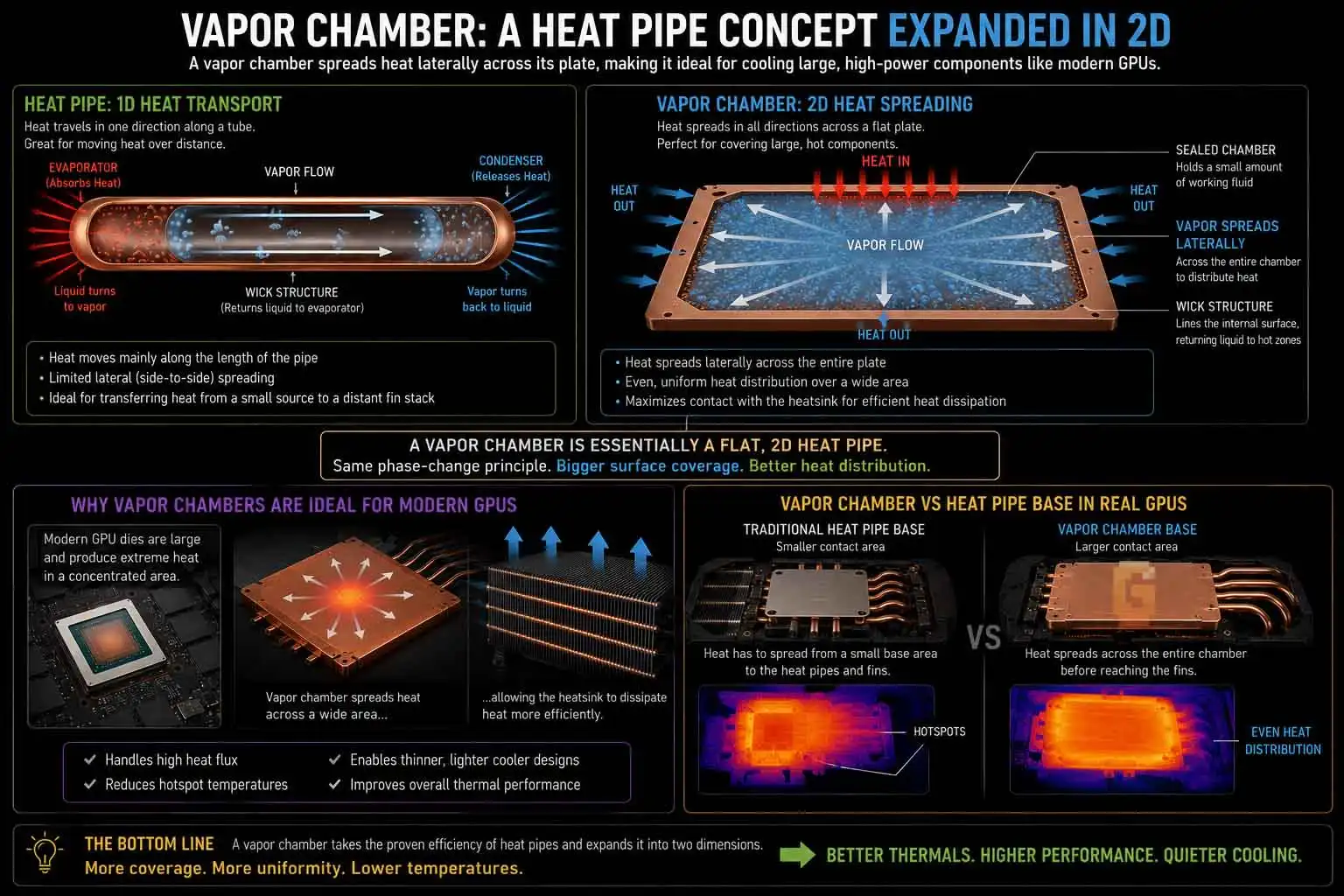
A vapor chamber is essentially a heat pipe concept expanded into a two-dimensional structure, making it particularly useful when heat needs to spread across a broad area.
Instead of sending heat primarily along one tubular path, a vapor chamber can spread heat laterally across its plate. That makes it especially attractive for modern GPUs.
ASUS describes vapor chambers as an increasingly important part of its graphics-card cooling designs and explains how vapor chambers use the same basic evaporation and condensation principle as traditional heat pipes. This also explains why the distinction between “heat pipe” and “vapor chamber” isn’t really a competition.
They’re related technologies solving related problems. A high-end GPU can use both. The vapor chamber can spread heat across the GPU’s contact region, while heat pipes can transport that heat toward additional fin-stack regions.
What About the Heat Pipes That Stick Out of a GPU Cooler?
Those protruding heat-pipe ends are usually a consequence of the physical routing and manufacturing of the cooler, rather than evidence that the manufacturer forgot to finish the heatsink.
A heat pipe can be routed through a fin stack and its sealed end may extend beyond the final fin or shroud boundary. That exposed tip isn’t the important heat-transfer surface. The useful part is the section of the heat pipe connecting the heated region to the condenser region inside the cooler.
So seeing a heat pipe extend slightly beyond the heatsink doesn’t automatically mean the design is better or worse. It’s mostly a consequence of how the manufacturer has packaged the heat-transfer system.
The same principle also explains why a GPU can have a very different-looking cooler without necessarily having worse thermal performance.
What This Means for How Your Cooler Is Actually Built
The most important lesson is that GPU cooling isn’t about finding the material with the highest thermal conductivity and using as much of it as possible. It’s about getting heat from a small source to a large radiator efficiently.
That’s why a modern high-end graphics card can contain a vapor chamber, multiple heat pipes, a huge fin stack, and several fans instead of simply being a massive block of copper.
- The heat pipe is essentially a transport system.
- The fins are the radiator.
- The fans are the airflow system.
- The vapor chamber is the heat-spreading stage.
- And the thermal interface material is the bridge between the GPU and the cooler.
Each component exists because it solves a different part of the thermal problem.
And this changes how you should judge a GPU cooler
When comparing two graphics cards, don’t simply count the number of heat pipes. Don’t assume a visible heat pipe is automatically useful because it is exposed. Don’t assume more copper automatically means better cooling. And don’t interpret a manufacturer’s “X times better thermal conductivity” statement as a universal number.
Instead, look at the entire thermal architecture. That includes the vapor chamber or base, heat-pipe routing, fin-stack size and density, fan design, airflow path, thermal interface, and the amount of heat the cooler is actually designed to remove. That is a much better way to understand the difference between two flagship GPU coolers.
The Bigger Picture: Why This Matters for RTX 5090
This is especially relevant when looking at very high-end RTX 5090 designs. At this level, manufacturers aren’t simply trying to make a GPU cooler. They’re trying to balance thermal performance, acoustics, physical size, weight, power delivery, structural rigidity, manufacturing complexity, and long-term reliability. That’s why two premium graphics cards can use noticeably different cooling architectures while both being highly sophisticated.
The next flagship generation will only raise the stakes further — our look at whether the RTX 6090 will be better than the 5090 covers what’s expected to change architecturally, including the power and thermal envelope future coolers will need to handle.
The ASUS ROG Matrix Platinum RTX 5090 is a good example of this. Its cooler doesn’t show the usual visibly protruding heat pipes other flagship cards do, which raises a natural question: is that an advantage or a disadvantage? The answer isn’t found by looking at the exposed pipe tips. You have to look at where the heat enters the cooler, how it spreads, how it travels to the fin stack, and how the fans move air through it. That’s the engineering story behind the appearance.
The answer isn’t found by looking at the exposed pipe tips. You have to look at where the heat is entering the cooler, how it spreads, how it travels to the fin stack, and how the fans move air through that fin stack. That is the engineering story behind the appearance. And it leads back to the original question:
“Why heat pipes instead of copper?”
Because the goal isn’t to own the most copper. The goal is to transport heat from the source to the place where air can remove it. Heat pipes are exceptionally good at that job.
Three Things to Remember
- Heat pipes aren’t simply “better copper.” They use a different heat-transfer mechanism based on evaporation, vapor transport, condensation, and capillary return.
- The real alternative isn’t a heat pipe versus a tiny copper block. It’s a heat pipe versus making a much larger, heavier solid copper structure capable of transporting heat across the same distance.
- GPUs are an ideal application. They produce concentrated heat in a relatively small area but require a physically large fin stack to reject that heat into the air.
That mismatch is exactly where heat pipes become valuable.
FAQ
Are heat pipes better than solid copper?
Heat pipes can transport heat much more effectively than solid copper over suitable distances, but their performance depends on geometry, heat load, and operating conditions.
Why don’t GPU manufacturers use one giant copper heatsink?
A giant copper heatsink would be heavy, expensive, and inefficient for transporting heat across a large cooler. Heat pipes provide a lighter way to move heat toward distant fin-stack areas.
Does a longer heat pipe perform worse?
A longer heat pipe generally has lower effective thermal conductivity than a shorter equivalent pipe, although it can still outperform solid conduction for the intended thermal transport task.
Are exposed heat-pipe ends useful for cooling?
The exposed end contributes relatively little compared with the portion of the pipe connected to the evaporator and condenser regions. Its presence is mainly a packaging consequence.
Is a vapor chamber better than heat pipes?
Neither is universally better. Vapor chambers are particularly useful for spreading heat across a broad area, while tubular heat pipes are useful for transporting heat between separated regions.
Conclusion: Why Heat Pipes Instead of Solid Copper?
The short answer is simple: heat pipes are used because efficiently transporting heat can be more important than simply having a highly conductive material.
Copper is excellent. But a solid copper block still has to conduct heat through itself, and that becomes increasingly challenging as the distance between the heat source and cooling surface grows.
A heat pipe takes a different approach. It uses a working fluid, evaporation, vapor movement, condensation, and capillary action to transport heat between two regions. Under appropriate conditions, its effective thermal conductivity can be dramatically higher than solid copper. And that’s exactly why GPUs benefit so much from the technology.
A GPU produces heat in a concentrated area, while its cooler needs a much larger fin surface spread across the graphics card. A heat pipe bridges that mismatch. So when you look at your next GPU cooler, don’t ask only: “How much copper does it have?”
Ask:
“How efficiently does this design move heat from the GPU to the entire fin stack?”
That’s the question that actually explains why heat pipes exist.
For the next step, compare the complete thermal architecture of two GPUs rather than just their heat-pipe count: vapor chamber, pipe routing, fin density, fan pressure, heatsink mass, and airflow path. That will tell you far more about cooling performance than the number of visible copper tubes.
References
NASA — State-of-the-Art Small Spacecraft Technology: Heat Pipes — A current NASA overview of heat-pipe construction, evaporation, condensation, capillary return, and thermal-control applications.
NASA — Mini Heat Pipes Wick Away Heat — NASA’s explanation of copper’s thermal conductivity and the effective conductivity possible with heat pipes.
Electronics Cooling — Design Considerations When Using Heat Pipes — Detailed discussion of effective thermal conductivity, heat-pipe length, and why published conductivity figures should not be treated as universal values.